
Which of the following statements are correct in regard to non-ideal binary solution (X) showing negative deviations from Raoult's law?
A. The vapour pressure of X is lower than that predicted by Raoult's law.
B. A mixture of chloroform and acetone forms a solution with negative deviation from Raoult's law.
C. The intermolecular attractive forces between A-A and B-B are weaker than those between A-B.
D. (ΔV)mixing = 0
Choose the correct answer from the options given below:
Answer & explanation
Correct answer: option 1
The correct answer is Option (1) → A, B and C only
An ideal solution obeys Raoult’s law at all compositions, with ΔmixH = 0 and ΔmixV = 0:
\( \displaystyle p=p_A^{\circ}x_A+p_B^{\circ}x_B \)
In a solution showing negative deviation, the A–B attractions are stronger than the A–A and B–B attractions. Molecules escape less easily, so the vapour pressure is lower than Raoult’s law predicts. Heat is released on mixing (ΔmixH < 0) and the volume contracts (ΔmixV < 0).
A. The vapour pressure of X is lower than that predicted by Raoult's law. — Correct. Stronger A–B attractions hold the molecules back, which lowers the vapour pressure.
B. A mixture of chloroform and acetone forms a solution with negative deviation from Raoult's law. — Correct. The hydrogen of chloroform forms a hydrogen bond with the oxygen of acetone. This new attraction is stronger than the forces in either pure liquid.
C. The intermolecular attractive forces between A-A and B-B are weaker than those between A-B. — Correct. The stronger A–B attractions (such as the hydrogen bond between chloroform and acetone) hold the molecules back, so fewer molecules escape and the vapour pressure falls; this is the cause of negative deviation.
D. (ΔV)mixing = 0 — Incorrect. ΔmixV = 0 holds only for an ideal solution. With negative deviation the molecules pack more closely, so ΔmixV < 0.
NCERT (2026-27 edition):
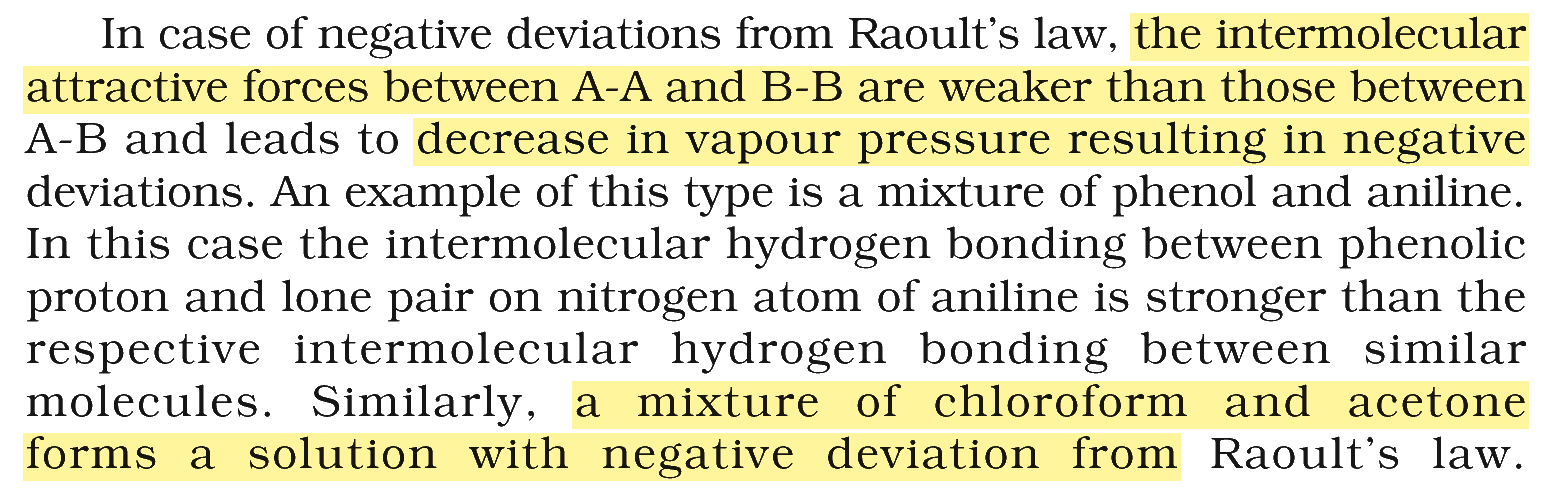
Non-ideal Solutions – …
Ideal Solutions – “The solutions which obey Raoult’s law over the entire range of concentration are known as ideal solutions. The ideal solutions have two other important properties. The enthalpy of mixing of the pure components to form the solution is zero and the volume of mixing is also zero, i.e., ΔmixH = 0, ΔmixV = 0. It means that no heat is absorbed or evolved when the components are mixed. Also, the volume of solution would be equal to the sum of volumes of the two components.”