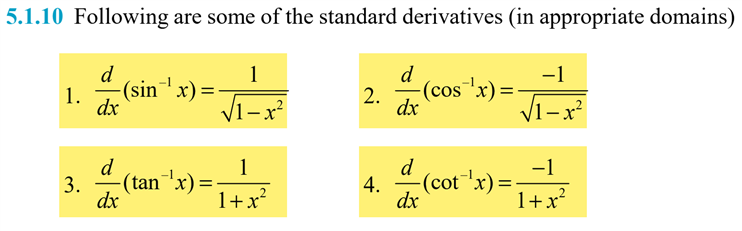
Match List I with List II
| LIST I (Functions) | LIST II (Derivatives) | ||
| A. | \(f(x) = \sin^{-1}x\) | I. | \(\displaystyle\frac{1}{1+x^2},\ x \in R\) |
| B. | \(f(x) = \tan^{-1}x\) | II. | \(\displaystyle\frac{1}{\sqrt{1-x^2}},\ x \in (-1, 1)\) |
| C. | \(f(x) = \cos^{-1}x\) | III. | \(-\displaystyle\frac{1}{\sqrt{1-x^2}},\ x \in (-1, 1)\) |
| D. | \(f(x) = \cot^{-1}x\) | IV. | \(-\displaystyle\frac{1}{1+x^2},\ x \in R\) |
Choose the correct answer from the options given below:
Answer & explanation
Correct answer: option 3
The correct answer is Option (3) → A-II, B-I, C-III, D-IV
These are the standard derivatives of the inverse trigonometric functions. The co-functions \(\cos^{-1}x\) and \(\cot^{-1}x\) have the same derivatives as \(\sin^{-1}x\) and \(\tan^{-1}x\) with a minus sign, because
\( \displaystyle \sin^{-1}x + \cos^{-1}x = \frac{\pi}{2},\qquad \tan^{-1}x + \cot^{-1}x = \frac{\pi}{2} \)
(A) \(f(x) = \sin^{-1}x\)
This matches (II) \(\frac{1}{\sqrt{1-x^2}},\ x \in (-1, 1)\).
\( \displaystyle \frac{d}{dx}\left(\sin^{-1}x\right) = \frac{1}{\sqrt{1-x^2}} \)
(B) \(f(x) = \tan^{-1}x\)
This matches (I) \(\frac{1}{1+x^2},\ x \in R\).
\( \displaystyle \frac{d}{dx}\left(\tan^{-1}x\right) = \frac{1}{1+x^2} \)
(C) \(f(x) = \cos^{-1}x\)
This matches (III) \(-\frac{1}{\sqrt{1-x^2}},\ x \in (-1, 1)\).
\( \displaystyle \frac{d}{dx}\left(\cos^{-1}x\right) = \frac{d}{dx}\left(\frac{\pi}{2} - \sin^{-1}x\right) = -\frac{1}{\sqrt{1-x^2}} \)
(D) \(f(x) = \cot^{-1}x\)
This matches (IV) \(-\frac{1}{1+x^2},\ x \in R\).
\( \displaystyle \frac{d}{dx}\left(\cot^{-1}x\right) = \frac{d}{dx}\left(\frac{\pi}{2} - \tan^{-1}x\right) = -\frac{1}{1+x^2} \)
NCERT Exemplar:
Continuity and Differentiability