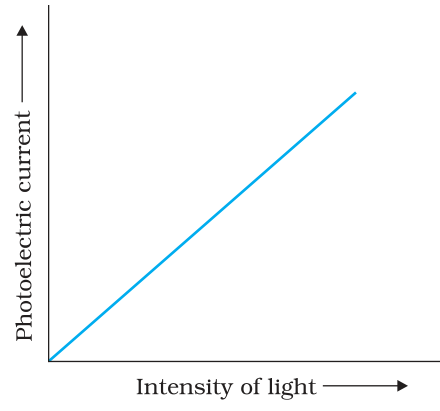
In an experiment on photoelectric effect, for a given photosensitive material and frequency of incident radiation (above the threshold frequency), the photocurrent
Answer & explanation
Correct answer: option 1
The correct answer is Option (1) → increases linearly with the intensity of the incident radiation.
In the photoelectric effect each photon can free at most one electron. For a fixed frequency above threshold, a more intense beam carries more photons per second, so more electrons are emitted per second. The photocurrent is a rate of flow of charge, so it depends on the number emitted per second, not on how long the light has been on.
Option (1) increases linearly with the intensity of the incident radiation. — Correct. The number of photoelectrons emitted per second is proportional to the number of photons per second, so the photocurrent is proportional to the intensity.
Option (2) increases, if the exposure time is increased. — Incorrect. A longer exposure releases more electrons in total, but the current (electrons per second) stays the same.
Option (3) saturates for large enough retarding potential. — Incorrect. The current saturates for a large enough accelerating potential; a retarding potential reduces it, to zero at the stopping potential.
Option (4) increases, if the exposure time is decreased. — Incorrect. Reducing the exposure time does not change the number of electrons emitted per second either.
NCERT (2026-27):
Effect of Intensity of Light on Photocurrent – “… It is found that the photocurrent increases linearly with intensity of incident light as shown graphically in Fig. 11.2. The photocurrent is directly proportional to the number of photoelectrons emitted per second.”