
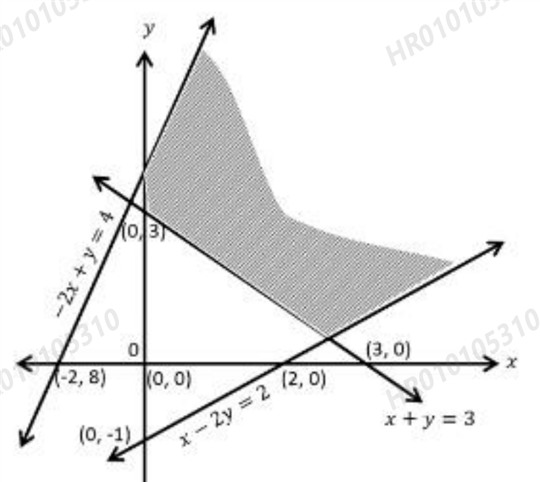
For any linear programming problem the feasible region is shaded region as given below, then constraints are:
Answer & explanation
Correct answer: option 2
The correct answer is Option (2) → \( -2x+y\le 4,\ x+y\ge 3,\ x-2y\le 2,\ x\ge 0,y\ge 0 \)
The boundary lines \( -2x+y=4 \), \( x+y=3 \) and \( x-2y=2 \) are printed on the graph. A point inside the shaded region, such as (3, 3), shows which side of each line is shaded.
\( \displaystyle -2x+y=-6+3=-3\lt 4\ \Rightarrow\ -2x+y\le 4 \)
\( \displaystyle x+y=3+3=6\gt 3\ \Rightarrow\ x+y\ge 3 \)
\( \displaystyle x-2y=3-6=-3\lt 2\ \Rightarrow\ x-2y\le 2 \)
The region is also in the first quadrant, so \( x\ge 0,\ y\ge 0 \). This is Option (2).
Why the other options are incorrect
Option (1) \( -2x+y\ge 4,\ x+y\ge 3,\ x-2y\ge 2,\ x\ge 0,y\ge 0 \) — Incorrect. At (3, 3), \( -2x+y=-3 \), which is not \( \ge 4 \); the shaded region is on the origin side of \( -2x+y=4 \) and of \( x-2y=2 \).
Option (3) \( -2x+y\le 4,\ x+y\le 3,\ x-2y\le 2,\ x\ge 0,y\ge 0 \) — Incorrect. At (3, 3), \( x+y=6 \), which is not \( \le 3 \); the shaded region lies on the far side of x + y = 3 from the origin.
Option (4) \( -2x+y\ge 4,\ x+y\le 3,\ x-2y\ge 2,\ x\ge 0,y\ge 0 \) — Incorrect. All three inequalities point the wrong way; (3, 3) satisfies none of them.