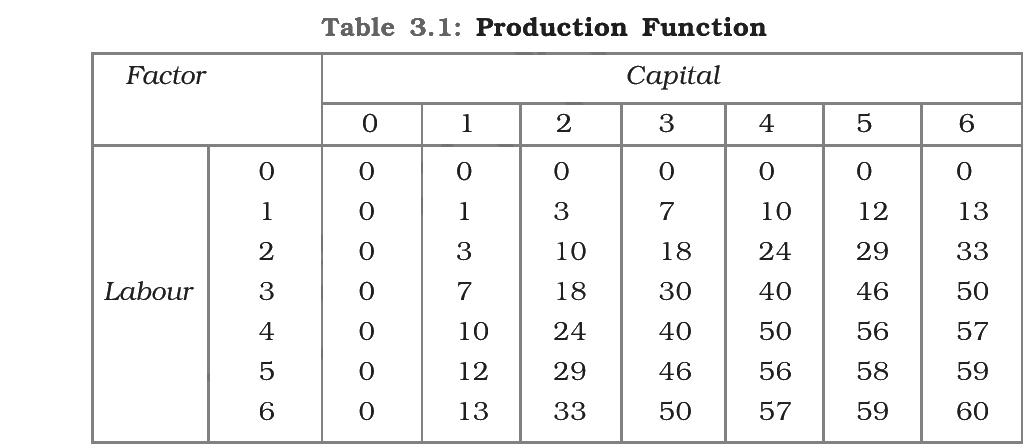
A production function gives the following outputs:
| Labour (L) / Capital (K) | 1 | 2 | 3 | 4 |
|---|---|---|---|---|
| 1 | 1 | 3 | 7 | 10 |
| 2 | 3 | 10 | 18 | 24 |
| 3 | 7 | 18 | 30 | 40 |
| 4 | 10 | 24 | 40 | 50 |
If capital is fixed at 2 units, what is the marginal product of the 3rd unit of labour?
Answer & explanation
Correct answer: option 1
The correct answer is Option (1) → 8 units
With capital fixed at 2, read the K = 2 column.
Given:
Output with 2 units of labour = 10 units
Output with 3 units of labour = 18 units
\( MP_L = TP_3 - TP_2 = 18 - 10 = 8 \)
MP of the 3rd unit = 8 units
Option (3) 12 units — this comes from the K = 3 column (30 − 18).
Option (4) 18 units — this is the TP itself, not the MP.
NCERT (2026-27): “3.3.3 Marginal Product Marginal product of an input is defined as the change in output per unit of change in the input when all other inputs are held constant. …”
|