
CUETMOCK
  • Pricing
  • Mentors
Log inStart freeStart free mocks→

First test, then trust

Try a free CUET mock test.

Join 5,00,000+ students who rehearsed exam day on the exact NTA screen before sitting CUET. On the web and on Android.

Start free mocks →Get the Android app
CUETMOCK

India's #1 CUET Mock Test Platform. Original NCERT-based questions on the exact NTA exam screen — trusted by 5,00,000+ students since CUET 2022.

Get it onGoogle PlayScan to download the CUETMOCK app

Mock tests

  • CUET mock test series
  • Commerce mocks
  • Humanities (Arts) mocks
  • Science mocks
  • Languages & GAT mocks
  • Free practice questions
  • Pricing

Resources

  • CUET exam guide
  • CUET syllabus
  • Universities accepting CUET
  • Expert blogs
  • News & notifications
  • Webinars & counselling
  • CUET score calculator
  • How we estimate your rank
  • FAQs

Company

  • About us
  • Our leadership & team
  • Our toppers
  • Mentors
  • For schools
  • Contact us
  • Terms
  • Privacy
  • Refund policy

Talk to us

+91 7696 6630 56info@cuetmock.comWhatsApp us

Our other platforms

  • JEE Mock — For IIT-JEE aspirants
  • NEET Mock — For NEET aspirants

Newsletter

Exam updates, study material and offers — no spam.

© 2026 NYC Ventures Pvt. Ltd.

701-702, Royal Business Park, Zirakpur, Punjab - 140603

  • Terms of use
  • Privacy policy
  • Refund policy
  • Contact us

iCUETMOCK is an independent preparation platform, not affiliated with the National Testing Agency (NTA). Always check exam details on the official NTA website.

  • Home
  • Mock tests
  • CUET guide
  • Pricing
  • Log in
Home/Practice questions/Chemistry
ChemistryOrganic: Haloalkanes and Haloarenes

Which of the following reactions takes place most readily by the SN2…

Which of the following reactions takes place most readily by the SN2 mechanism?

Answer & explanation+

Correct answer: option 1

The correct answer is Option (1) → \( \ce{CH3Br + OH^- -> CH3OH + Br^-} \)

  • An SN2 reaction (substitution nucleophilic bimolecular) takes place in one step. The nucleophile attacks the carbon from the side opposite to the leaving group, and the new bond forms as the old one breaks. The rate depends on both the alkyl halide and the nucleophile:

        \( \displaystyle \text{Rate}=k[\ce{RX}][\ce{Nu^-}] \)

  • Because the nucleophile must reach the carbon bearing the halogen, bulky groups on that carbon slow the reaction (steric hindrance). The fewer and smaller the groups, the faster the SN2 reaction:

        \( \displaystyle \ce{CH3X} \gt 1^\circ \gt 2^\circ \gt 3^\circ \)

  • In bromomethane the carbon carries only three small hydrogen atoms, so the hydroxide ion reaches it most easily:

        \( \displaystyle \ce{CH3Br + OH^- -> CH3OH + Br^-} \)

Why the other options are incorrect

Option (2) 2-bromopropane + OH– → propan-2-ol + Br– — Incorrect.

  • 2-Bromopropane is a secondary halide: the carbon bearing bromine also carries two methyl groups.

  • It can react by SN2, but the two methyl groups crowd the path of the nucleophile, so it reacts far more slowly than bromomethane.

        \( \displaystyle \ce{CH3-CH(Br)-CH3 + OH^- -> CH3-CH(OH)-CH3 + Br^-} \)

Option (3) ethanol → ethene + H2O (dehydration) — Incorrect. This is an elimination reaction, not a substitution. Ethanol loses a molecule of water when heated with concentrated sulphuric acid at 443 K, and a double bond forms.

    \( \displaystyle \ce{CH3CH2OH} \xrightarrow[\text{443 K}]{\text{conc. }\ce{H2SO4}} \ce{CH2=CH2 + H2O} \)

Option (4) 2-bromo-2-methylpropane + OH– → 2-methylpropan-2-ol + Br– — Incorrect.

  • 2-Bromo-2-methylpropane is a tertiary halide. Three methyl groups block the carbon, so SN2 attack is almost impossible.

  • This reaction goes by the SN1 route instead: the C–Br bond first breaks to give a tertiary carbocation, which then combines with \( \ce{OH^-} \).

        \( \displaystyle \ce{(CH3)3CBr + OH^- -> (CH3)3COH + Br^-} \)

NCERT (2026-27 edition):
(a) Substitution nucleophilic bimolecular (SN2) – “… Since this reaction requires the approach of the nucleophile to the carbon bearing the leaving group, the presence of bulky substituents on or near the carbon atom have a dramatic inhibiting effect. Of the simple alkyl halides, methyl halides react most rapidly in SN2 reactions because there are only three small hydrogen atoms.”
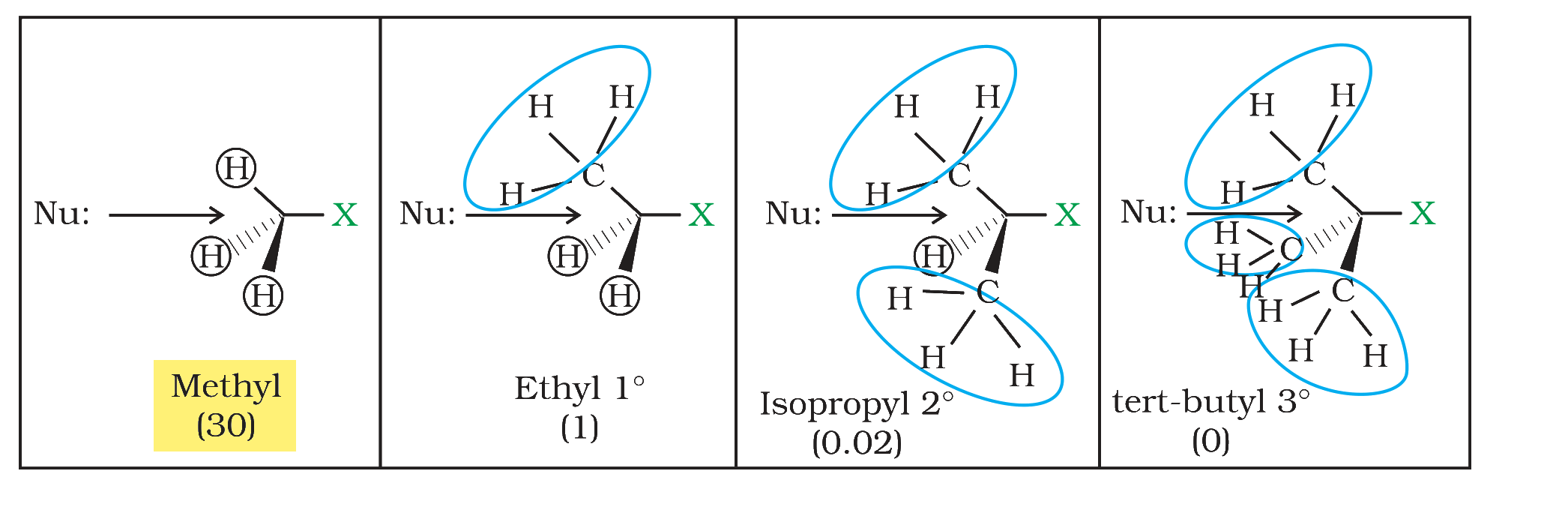
Textbook extract

Advertisement

Practise more on Organic: Haloalkanes and Haloarenes

Chapter-wise mocks on the real NTA exam screen, with solutions and your rank. Your first mocks are free.

Start free mocks →

Advertisement

Next questions

  1. Arrange in chronological order the following major advances in Indian Epigraphy beginning with the earliest to the most recent.(A) D. C. Si…General Aptitude Test · General Knowledge
  2. Observe the image and answer the following question.Identify this painting and the school to which it belongs.Fine Arts · The Pahari Schools of Painting
  3. Jamshedpur, the steel town that grew around the TISCO works near the Mumbai–Kolkata railway line, is in which state?General Aptitude Test · General Knowledge
  4. Given below are two statements: one is labelled as Assertion (A) and the other is labelled as Reason (R).Assertion (A): The level of unempl…Economics · Micro Economics: Introduction
  5. Match List-I with List-II.List-I(Equation)List-II(What the equation expresses)(A) Δ_r G^° = -nFE^°_cell (I) Kohlrausch law of independent m…Chemistry · Physical: Electro Chemistry
  6. Change the following sentence into an Exclamatory sentence:The band played very lively music at the temple fair.English · Kinds of Sentence
  7. Mahatma Gandhi’s first major public appearance in India after his return from abroad was at the opening ceremony of which institution?General Aptitude Test · General Knowledge
  8. निम्नलिखित पंक्तियों में कौन-सा छंद है?"भोर हुई चिड़ियाँ सब जागीं, दाना चुगने वन को भागीं।सूरज ने किरणें बिखराईं, फूलों ने खुशियाँ बरसाईं।।"Hindi · छंद
  9. Select the word which can replace the given phrase:A period of paid leave given to a teacher or other worker for study or travelEnglish · One Word
  10. In Basohli painting, how is the representation of pearls in ornaments imitated?Fine Arts · The Pahari Schools of Painting