A photon is found to have a frequency of \( 9.4\times10^{10}\,\mathrm{Hz} \). To which region of the electromagnetic spectrum does it belong?
Answer & explanation
Correct answer: option 3
The correct answer is Option (3) → Microwaves
The region of the electromagnetic spectrum is fixed by the wavelength, which follows from \( \nu\lambda=c \) with \( c=3\times10^{8}\,\mathrm{m\,s^{-1}} \).
\( \begin{aligned} \lambda &= \frac{c}{\nu} \\ &= \frac{3\times10^{8}\,\mathrm{m\,s^{-1}}}{9.4\times10^{10}\,\mathrm{Hz}} \\ &\approx 3.2\times10^{-3}\,\mathrm{m} \end{aligned} \)
Therefore, the wavelength is about 3.2 mm.
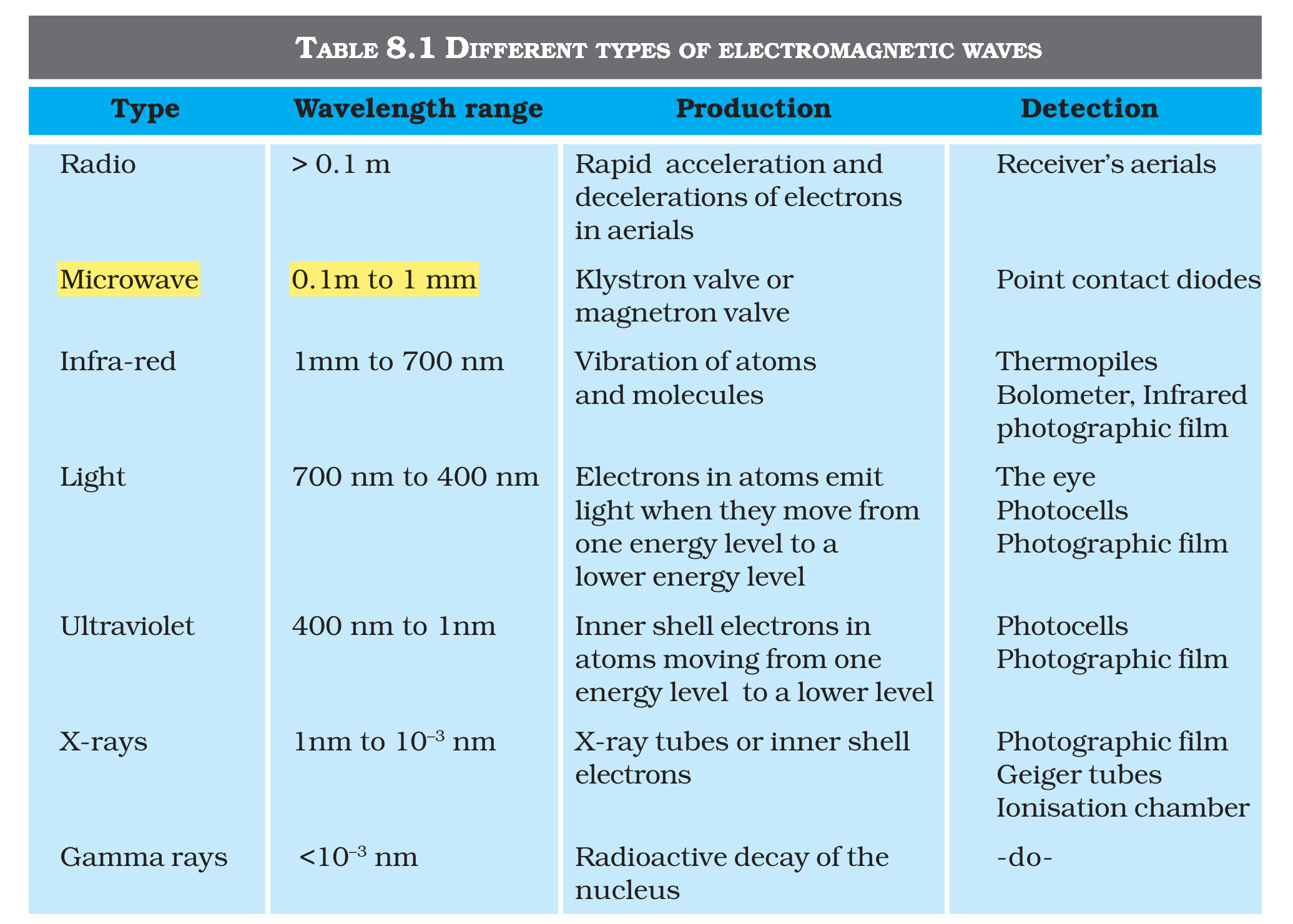
Option (1) Radio waves — Incorrect. Radio waves have wavelengths longer than 0.1 m.
Option (2) Gamma rays — Incorrect. Gamma rays have wavelengths below \( 10^{-3}\,\mathrm{nm} \). This is far smaller than 3.2 mm.
Option (3) Microwaves — Correct. Microwaves cover wavelengths from 0.1 m to 1 mm, and 3.2 mm lies inside this band.
Option (4) Ultraviolet rays — Incorrect. Ultraviolet rays have wavelengths from 400 nm down to about 1 nm.
NCERT (2026-27):
Electromagnetic Spectrum