
CUETMOCK
  • Pricing
  • Mentors
Log inStart freeStart free mocks→

First test, then trust

Try a free CUET mock test.

Join 5,00,000+ students who rehearsed exam day on the exact NTA screen before sitting CUET. On the web and on Android.

Start free mocks →Get the Android app
CUETMOCK

India's #1 CUET Mock Test Platform. Original NCERT-based questions on the exact NTA exam screen — trusted by 5,00,000+ students since CUET 2022.

Get it onGoogle PlayScan to download the CUETMOCK app

Mock tests

  • CUET mock test series
  • Browse all papers
  • Commerce mocks
  • Humanities (Arts) mocks
  • Science mocks
  • Languages & GAT mocks
  • Free practice questions
  • Pricing

Resources

  • CUET exam guide
  • CUET syllabus
  • Universities accepting CUET
  • Expert blogs
  • News & notifications
  • Webinars & counselling
  • CUET score calculator
  • How we estimate your rank
  • FAQs

Company

  • About us
  • Our leadership & team
  • Our toppers
  • Mentors
  • For schools
  • Contact us
  • Terms
  • Privacy
  • Refund policy

Talk to us

+91 7696 6630 56info@cuetmock.comWhatsApp us

Our other platforms

  • JEE Mock — For IIT-JEE aspirants
  • NEET Mock — For NEET aspirants

Newsletter

Exam updates, study material and offers — no spam.

© 2026 NYC Ventures Pvt. Ltd.

701-702, Royal Business Park, Zirakpur, Punjab - 140603

  • Terms of use
  • Privacy policy
  • Refund policy
  • Contact us

iCUETMOCK is an independent preparation platform, not affiliated with the National Testing Agency (NTA). Always check exam details on the official NTA website.

  • Home
  • Mock tests
  • CUET guide
  • Pricing
  • Log in
Home/Practice questions/Chemistry
ChemistryPhysical: Chemical Kinetics

Which of the following best explains the effects of a catalyst on the…

Which of the following best explains the effects of a catalyst on the rate of a reversible reaction?

Answer & explanation+

Correct answer: option 4

The correct answer is Option (4) → It provides a new reaction path with a lower activation energy

  • A catalyst gives the reaction a different path with a lower activation energy. At the same temperature, a larger fraction of molecules now has enough energy to cross the lower barrier, so the reaction goes faster.

  • In a reversible reaction it speeds up the forward and backward reactions to the same extent, so equilibrium is reached sooner but does not change.

Why the other options are incorrect

Option (1) It decreases the rate of the reverse reaction — Incorrect. A catalyst speeds up the reverse reaction too, as much as the forward one.

Option (2) It increases the kinetic energy of the reacting molecules — Incorrect. The kinetic energy of the molecules depends on the temperature, which the catalyst does not change. A catalyst lowers the energy barrier instead of raising the energy of the molecules.

Option (3) It moves the equilibrium position to the right — Incorrect. A catalyst does not change the equilibrium constant; it only helps the system reach the same equilibrium faster.

NCERT (2026-27 edition):
3.4.1 Effect of Catalyst – “A catalyst is a substance which increases the rate of a reaction without itself undergoing any permanent chemical change. … It is believed that the catalyst provides an alternate pathway or reaction mechanism by reducing the activation energy between reactants and products and hence lowering the potential energy barrier as shown in Fig. 3.11. It is clear from Arrhenius equation (3.18) that lower the value of activation energy faster will be the rate of a reaction.”

    \( \displaystyle k = A\,e^{-E_a/RT} \qquad (3.18) \)
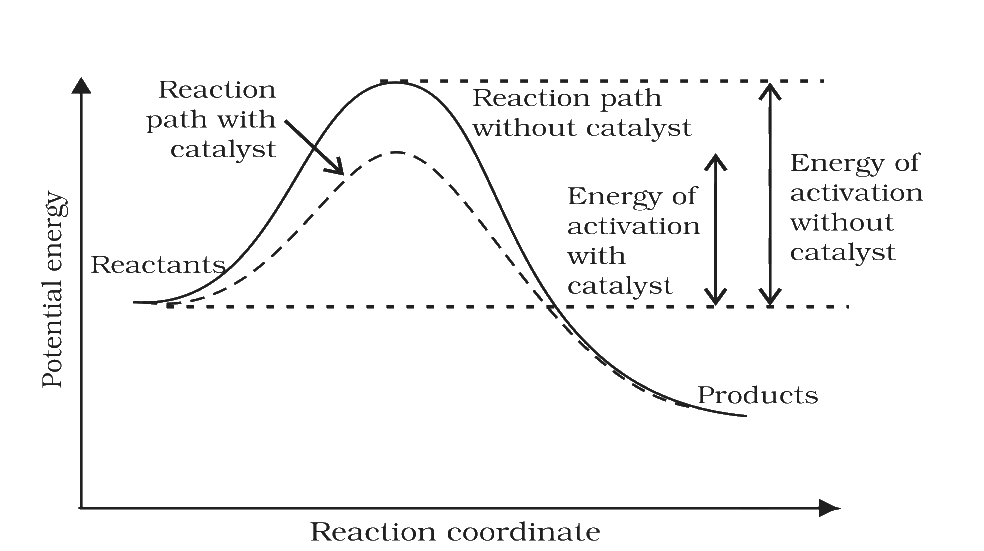
Fig. 3.11

Fig. 3.11: Effect of catalyst on activation energy

Advertisement

Practise more on Physical: Chemical Kinetics

Chapter-wise mocks on the real NTA exam screen, with solutions and your rank. Your first mocks are free.

Start free mocks →

Advertisement

Next questions

  1. '-इमा' प्रत्यय से बनी भाववाचक संज्ञाएँ (जैसे — लालिमा, महिमा) किस लिंग की होती हैं?Hindi · लिंग
  2. The diagonal of a cube is 6√3 cm. Its surface area and volume are:General Aptitude Test · Quantitative Reasoning
  3. The table shows Werner’s formulation of four cobalt(III) chloride–ammonia complexes.Which of the following correctly describes the relation…Chemistry · Inorganic: Coordination Compounds
  4. Assertion (A): The aggregate demand line of the two-sector model is parallel to the consumption function.Reason (R): The aggregate demand f…Economics · Macro Economics: Determination of Income and Employment
  5. As per the Companies Act, 1956, a company shall hold the first meeting of board of directors within how many days of the date of its incorp…Accountancy Part A · Accounting for Shares
  6. The value of […] isMaths. Section B1 · Determinants
  7. Consider the following statements: (A) displaystyled/dx≤ft(sin^-1x + cos^-1x) = 0 , -1 lt x lt 1 (B) displaystyled/dx≤ft(tan^-1x) = 1/(1 +…Maths. Section B1 · Continuity and Differentiability
  8. Choose the most appropriate synonym of the underlined word.A few boys at the back began to heckle the speaker during the debate on school u…English · Synonyms
  9. The value of ∫_0^(π)/4tan x dx isMaths. Section B1 · Definite Integration
  10. In which year was the People’s Republic of China set up?General Aptitude Test · General Knowledge