
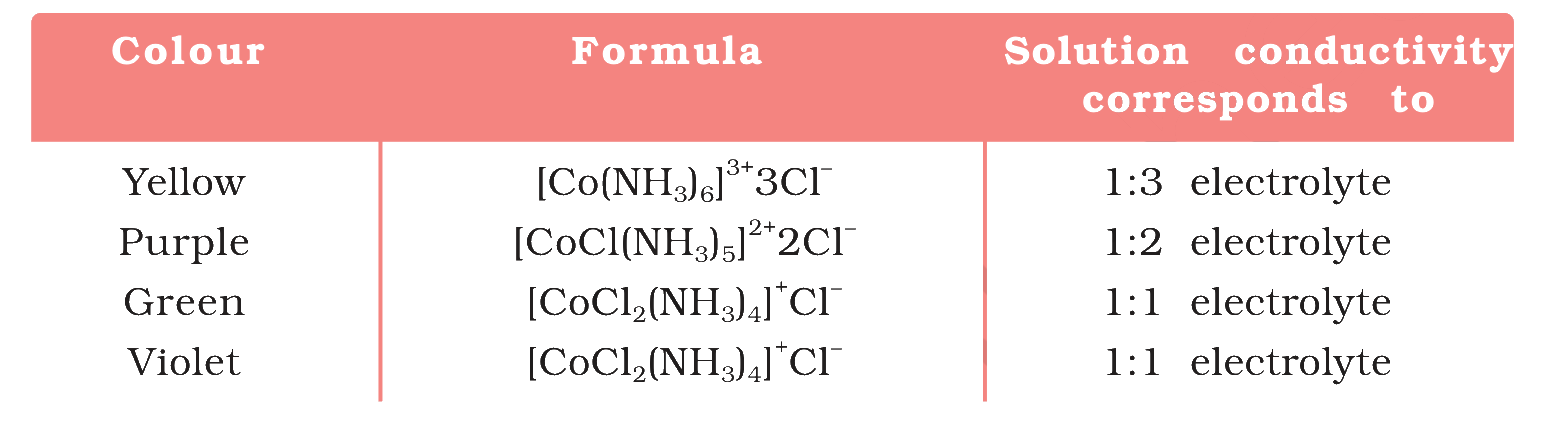
The table shows Werner’s formulation of four cobalt(III) chloride–ammonia complexes.
Which of the following correctly describes the relationship between the green complex and the violet complex?
Answer & explanation
Correct answer: option 3
The correct answer is Option (3) → They are stereoisomers: the same ligands are bound to cobalt in both, but they are arranged differently in space.
Stereoisomers have the same chemical formula and the same chemical bonds but a different spatial arrangement; structural isomers (linkage, coordination, ionisation, solvate) have different bonds. The table decides which kind is possible here.
What the table shows — Same formula, same ions. Both complexes are \( \ce{[CoCl2(NH3)4]^+ Cl-} \), and both are 1:1 electrolytes. So the same six groups, four NH3 and two Cl, are bonded to cobalt in both, and the same Cl− ion is outside the bracket.
How they differ — Arrangement in space. With the same bonds, only the arrangement of the ligands around cobalt can differ. For this octahedral entity of the type [MX2L4] the two chlorido ligands may be cis or trans to each other, so the two forms are geometrical isomers.
Why the other options are incorrect
Option (1) They are ionisation isomers: the two complexes give different ions in solution. — Incorrect. Ionisation isomers exchange a ligand with the counter ion, so they give different ions. Here both give \( \ce{[CoCl2(NH3)4]^+} \) and \( \ce{Cl^-} \), with the same 1:1 conductivity.
Option (2) They are coordination isomers: the ligands are interchanged between a complex cation and a complex anion. — Incorrect. Coordination isomerism needs both a cationic and an anionic complex entity, with different metal ions. Here the only anion is a simple Cl− ion, and cobalt is the only metal.
Option (4) They are solvate isomers: a water molecule is bound to cobalt in one and is free in the crystal lattice of the other. — Incorrect. Neither formula in the table contains water.
NCERT (2026-27 edition):
5.4 Isomerism in Coordination Compounds – “Stereoisomers have the same chemical formula and chemical bonds but they have different spatial arrangement. Structural isomers have different bonds.”
5.1 Werner’s Theory of Coordination Compounds – “…the last two compounds in Table 5.1 have identical empirical formula, CoCl3.4NH3, but distinct properties. Such compounds are termed as isomers.”
“Thus, [Co(NH3)6]3+, [CoCl(NH3)5]2+ and [CoCl2(NH3)4]+ are octahedral entities…”
5.4.1 Geometric Isomerism – “Such isomerism is not possible for a tetrahedral geometry but similar behaviour is possible in octahedral complexes of formula [MX2L4] in which the two ligands X may be oriented cis or trans to each other…”
5.4.4 Coordination Isomerism – “This type of isomerism arises from the interchange of ligands between cationic and anionic entities of different metal ions present in a complex.”
5.4.5 Ionisation Isomerism – “This form of isomerism arises when the counter ion in a complex salt is itself a potential ligand and can displace a ligand which can then become the counter ion.”
5.4.6 Solvate Isomerism – “…Solvate isomers differ by whether or not a solvent molecule is directly bonded to the metal ion or merely present as free solvent molecules in the crystal lattice.”
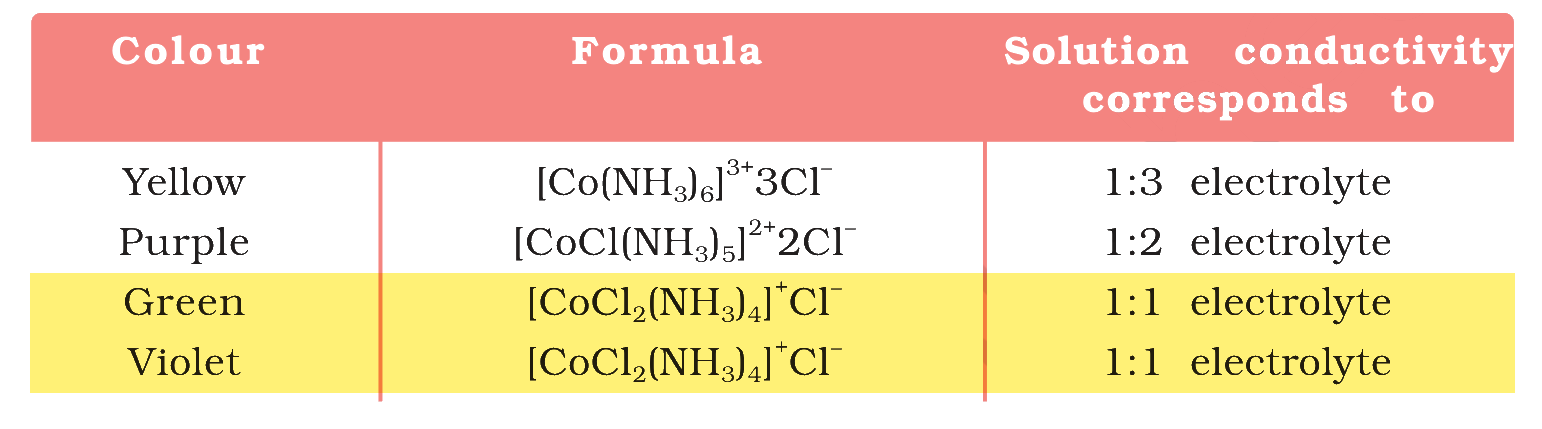
Table 5.1: Formulation of Cobalt(III) Chloride-Ammonia Complexes