In the case of price elasticity associated with straight line supply curves, when ES < 1, then -
Answer & explanation
Correct answer: option 3
The correct answer is Option (3) → It will start below the origin point also known as negative intercept
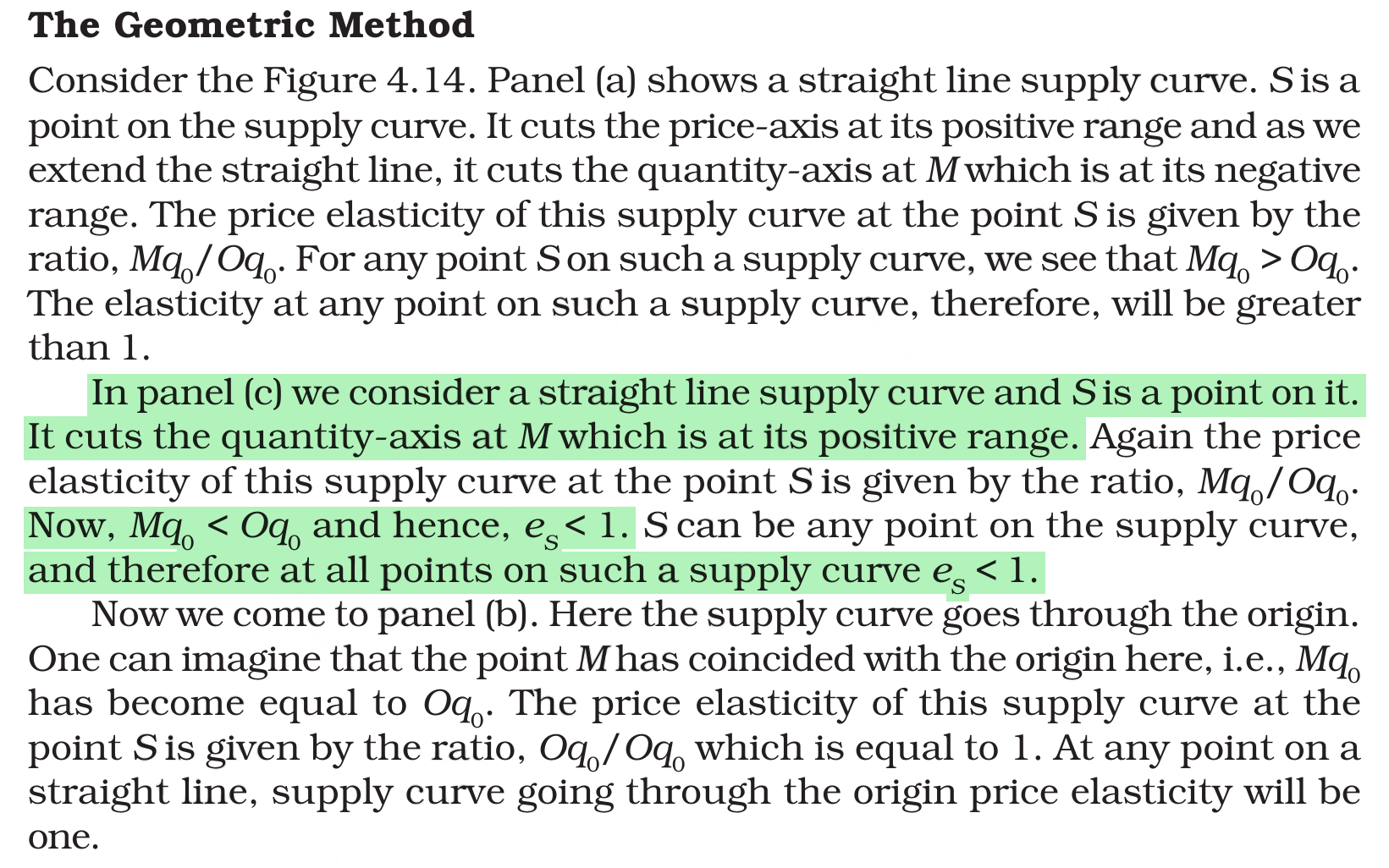
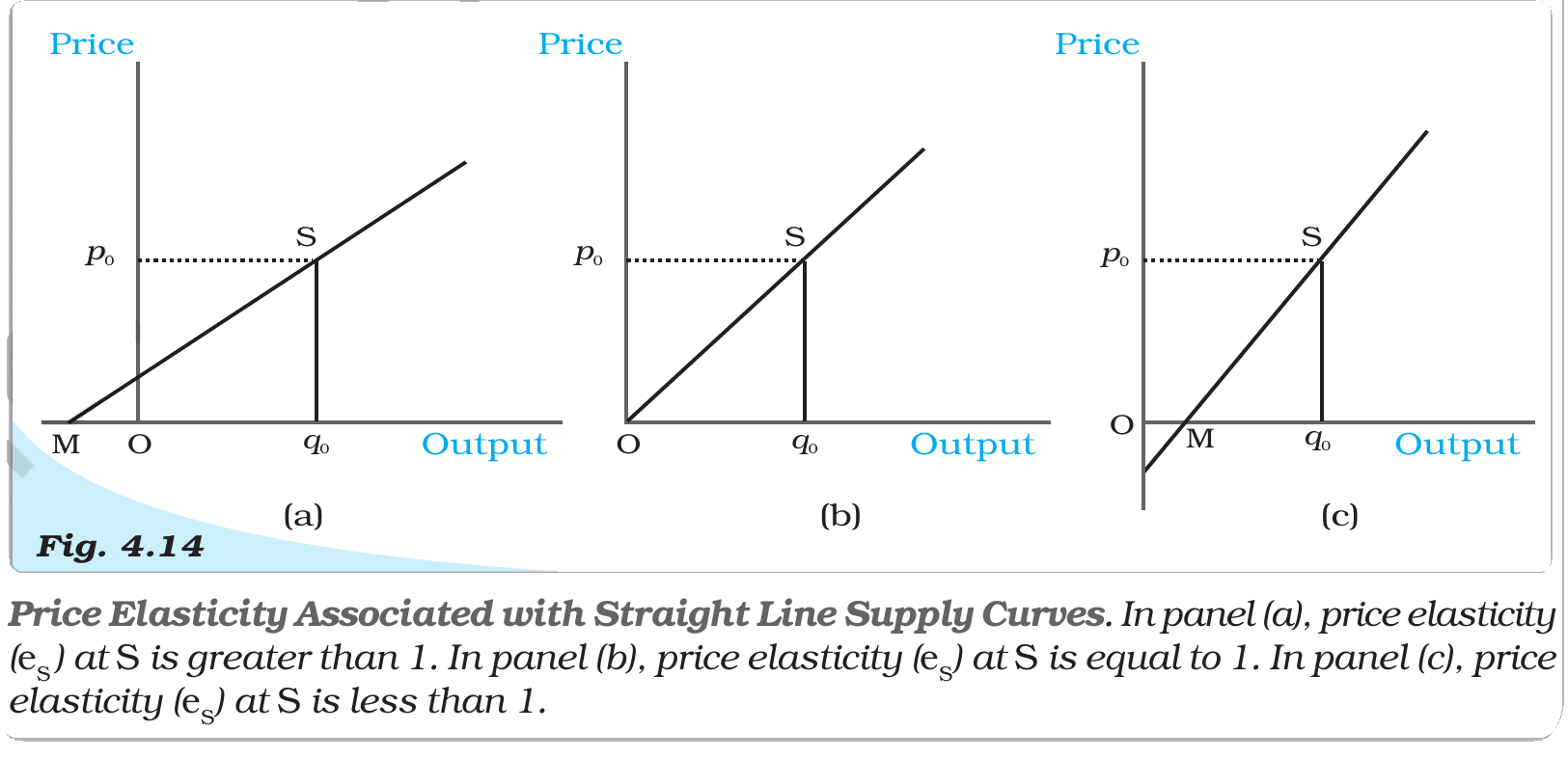
The price elasticity of supply tells us how strongly quantity supplied responds to price, and on a straight-line supply curve it can be read straight off the graph. At a point S, let q0 be the quantity supplied, and let the line, extended if necessary, meet the quantity axis at M. Then
eS = Mq0/Oq0
The elasticity therefore depends only on where the line meets the axes:
A line starting on the price axis above the origin (a positive intercept): extended, it meets the quantity axis at M to the left of O. Then Mq0 > Oq0 and eS > 1 at every point.
A line through the origin: M coincides with O, so Mq0 = Oq0 and eS = 1 at every point.
A line starting on the quantity axis at M, to the right of O: now Mq0 < Oq0 and eS < 1 at every point. Extended backwards, such a line passes below the origin and cuts the price axis at a negative value. That is why it is described as starting below the origin, with a negative intercept.
Each kind of line gives one result at every point on it. A line that starts above the origin always gives eS > 1, so eS < 1 cannot come from a line whose intercept may lie either above or below the origin.
NCERT: Introductory Microeconomics — Chapter 4: The Theory of the Firm under Perfect Competition (2025-26)
|