Comprehension:
Physical and Chemical properties of Amines
Like ammonia, nitrogen atom of amines is trivalent and carries an unshared pair of electrons. Nitrogen orbitals in amines are therefore, sp3 hybridised. Each of the three sp3 hybridised orbitals of nitrogen overlap with orbitals of hydrogen or carbon depending upon the composition of the amines. The fourth orbital of nitrogen in all amines contains an unshared pair of electrons. Amines have an unshared pair of electrons on nitrogen atom due to which they behave as Lewis base as well as act as a nucleophile. Lower aliphatic amines are soluble in water because they form hydrogen bond with water molecules and also form strong intermolecular hydrogen bonding. Solvation, +I and +R groups affect the electron density over nitrogen atom. Their pKb value lies in the range of 3 to 4.22. The most widely used method for preparing amines involves the reduction of nitro group, nitriles, amides, etc. using different reagents like H2/Pd, Sn+HCl, H2/Ni, LiAlH4+H2O, Br2+NaOH etc. Primary amines can be easily detected by the carbylamine test and Hinsberg's reagent. Diazonium salt can be synthesized from amines easily for synthesis of variety of new compounds.
The final product formed when aniline is treated with NaNO2 and HCl at 273-278K is
Answer & explanation
Correct answer: option 1
The correct answer is Option (1) → Benzenediazonium chloride
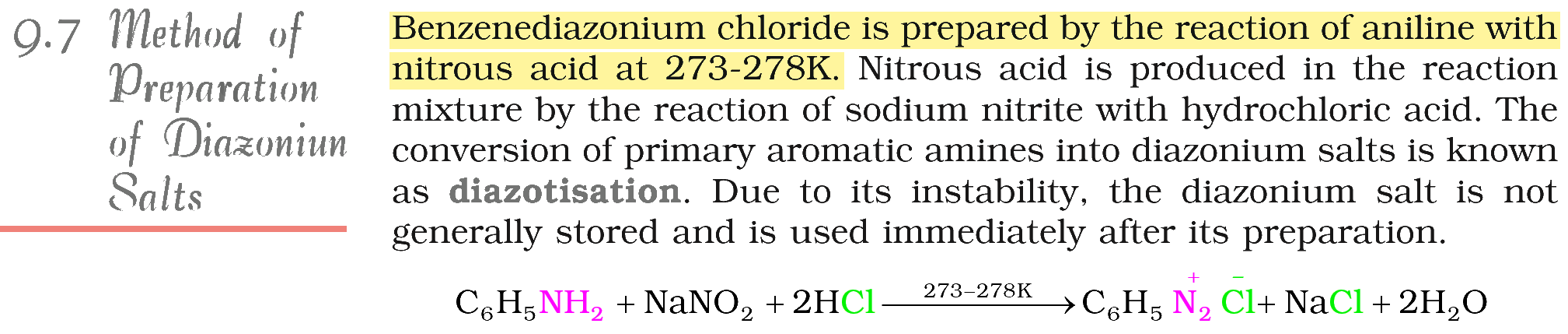
When a primary aromatic amine is treated with sodium nitrite and hydrochloric acid in the cold (273–278 K), it is converted into an arenediazonium salt. This reaction is called diazotisation. Nitrous acid, produced in the mixture, reacts with the –\( \ce{NH2} \) group:
\( \displaystyle \ce{NaNO2 + HCl -> HNO2 + NaCl} \)
\( \displaystyle \ce{C6H5NH2 + NaNO2 + 2HCl} \xrightarrow{273\text{-}278\ \mathrm{K}} \ce{C6H5N2^+Cl^- + NaCl + 2H2O} \)
The low temperature is essential: benzenediazonium chloride is stable only in cold solution and decomposes on warming. So the product is benzenediazonium chloride.
Why the other options are incorrect
Option (2) Benzonitrile — Incorrect. It is made from the diazonium salt in a further step, by the Sandmeyer reaction with CuCN/KCN:
\( \displaystyle \ce{C6H5N2^+Cl^-} \xrightarrow{\ce{CuCN}/\ce{KCN}} \ce{C6H5CN + N2} \)
Option (3) Phenol — Incorrect. It forms only if the diazonium salt solution is warmed (above about 283 K) and hydrolysed:
\( \displaystyle \ce{C6H5N2^+Cl^- + H2O -> C6H5OH + N2 + HCl} \)
Option (4) Nitrobenzene — Incorrect. Nitrous acid does not oxidise the amino group to a nitro group; nitrobenzene is the compound whose reduction gives aniline.
NCERT (2026-27 edition):
Method of Preparation of Diazonium Salts