
CUETMOCK
  • Pricing
  • Mentors
Log inStart freeStart free mocks→

First test, then trust

Try a free CUET mock test.

Join 5,00,000+ students who rehearsed exam day on the exact NTA screen before sitting CUET. On the web and on Android.

Start free mocks →Get the Android app
CUETMOCK

India's #1 CUET Mock Test Platform. Original NCERT-based questions on the exact NTA exam screen — trusted by 5,00,000+ students since CUET 2022.

Get it onGoogle PlayScan to download the CUETMOCK app

Mock tests

  • CUET mock test series
  • Commerce mocks
  • Humanities (Arts) mocks
  • Science mocks
  • Languages & GAT mocks
  • Free practice questions
  • Pricing

Resources

  • CUET exam guide
  • CUET syllabus
  • Universities accepting CUET
  • Expert blogs
  • News & notifications
  • Webinars & counselling
  • CUET score calculator
  • How we estimate your rank
  • FAQs

Company

  • About us
  • Our leadership & team
  • Our toppers
  • Mentors
  • For schools
  • Contact us
  • Terms
  • Privacy
  • Refund policy

Talk to us

+91 7696 6630 56info@cuetmock.comWhatsApp us

Our other platforms

  • JEE Mock — For IIT-JEE aspirants
  • NEET Mock — For NEET aspirants

Newsletter

Exam updates, study material and offers — no spam.

© 2026 NYC Ventures Pvt. Ltd.

701-702, Royal Business Park, Zirakpur, Punjab - 140603

  • Terms of use
  • Privacy policy
  • Refund policy
  • Contact us

iCUETMOCK is an independent preparation platform, not affiliated with the National Testing Agency (NTA). Always check exam details on the official NTA website.

  • Home
  • Mock tests
  • CUET guide
  • Pricing
  • Log in
Home/Practice questions/Chemistry
ChemistryOrganic: Alcohols, Phenols and Ethers

Bromination of phenol with bromine water gives product A while bromin…

Bromination of phenol with bromine water gives product A while bromination of phenol with Br2-CS2 and at low temperature gives product B as a major product. Identify the products A and B in the reaction.

Answer & explanation+

Correct answer: option 3

The correct answer is Option (3) → A is 2,4,6-tribromophenol while B is 4-bromophenol

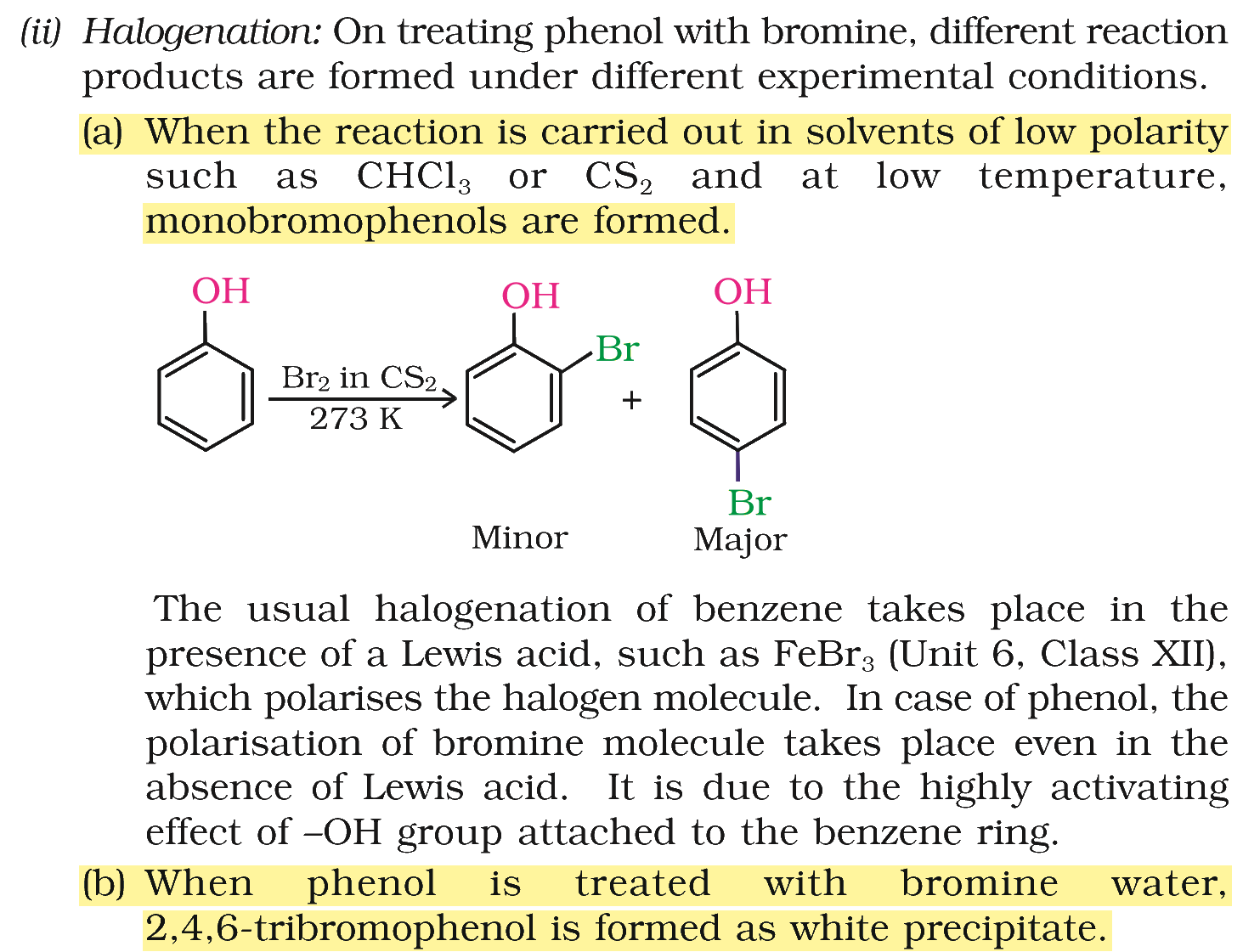
The –OH group of phenol is strongly activating and ortho/para directing: its lone pair pushes electron density into the ring by resonance. So phenol undergoes bromination even without a Lewis acid, and the solvent decides how far the reaction goes:

  • Br2 in a non-polar solvent (CS2 or CHCl3) at low temperature (273 K): phenol hardly ionises, and the \( \ce{Br2} \) molecule is only weakly polarised. The reaction is mild and gives monobromophenols, mainly the para isomer (the ortho positions are more hindered).

        \( \displaystyle \ce{C6H5OH} \xrightarrow[\text{273 K}]{\ce{Br2}\text{ in }\ce{CS2}} \text{p-bromophenol (major)} + \text{o-bromophenol (minor)} + \ce{HBr} \)

  • Bromine water: in water, phenol partly ionises to the phenoxide ion, which is even more strongly activated, and water polarises \( \ce{Br2} \). All three ortho and para positions are substituted at once, giving a white precipitate of 2,4,6-tribromophenol.

        \( \displaystyle \ce{C6H5OH + 3Br2} \xrightarrow{\ce{H2O}} \ce{C6H2Br3OH v + 3HBr} \)

In this question the labels are the other way round: A is formed in bromine water and B in \( \ce{CS2} \). So A is 2,4,6-tribromophenol and B is 4-bromophenol (p-bromophenol).

Why the other options are incorrect

  • Option (1) A is 4-bromophenol, while B is 2,4,6-tribromophenol. — Incorrect. The two products are interchanged. Tribromination needs the strong activation available in water, not the milder conditions in \( \ce{CS2} \).

  • Option (2) A is 2,4-dibromophenol, while B is 2-bromophenol. — Incorrect. Tribromination, not dibromination, takes place in bromine water; and in \( \ce{CS2} \) the major product is the para isomer, not 2-bromophenol.

  • Option (4) A is 2-bromophenol and B is 2,4,6-tribromophenol. — Incorrect. In water all three positions are substituted, so A cannot be a monobromo compound; and tribromination does not occur in \( \ce{CS2} \) at low temperature.

NCERT (2026-27 edition):
Halogenation
Textbook extract

Note: The same/similar question has been asked in different years by NTA as per the details given below:

20262025202420232022
20-05 S2
12-05 S2
––––

Advertisement

Practise more on Organic: Alcohols, Phenols and Ethers

Chapter-wise mocks on the real NTA exam screen, with solutions and your rank. Your first mocks are free.

Start free mocks →

Advertisement

Next questions

  1. In a certain code language, 'pic vic nic' means 'winter is cold'; 'to nic re' means 'summer is hot'; 're pic boo' means 'winter and summer'…General Aptitude Test · Verbal Reasoning
  2. In the following question, select that combination of the parts A, B, C, D, and E which can fit into each other to form a complete square.C…General Aptitude Test · Non-Verbal Reasoning
  3. Rohit wanted to buy 200 shares of a tech company. He contacted a stock exchange broker to buy the said shares. The broker opened his DEMAT…Business Studies · Financial Markets
  4. Debt-equity ratio is a sub-part of:Accountancy Part B · Accounting Ratios
  5. Identify a factor, which does not affect Hardy-Weinberg equilibrium.Biology · Evolution
  6. Match the LIST-I with LIST-IILIST-I(Summit/Conference)LIST-II(Year)A.The Bandung ConferenceI.1961B.First Summit of the NAMII.1947C.Asian Re…Political Science · Politics in India Since Independence: India's External Relations
  7. Choose the most appropriate passive construction of the following sentence from the options given below:His friends assured him of various…English · Grammar: Active Passive Voice
  8. Mendel gave the name “factors” to-Biology · Principles of Inheritance and Variation
  9. The final product formed when aniline is treated with NaNO2 and HCl at 273-278K isChemistry · Organic: Amines
  10. The graph of a function f:R→ R is shown below, where R is a real numbersThen which of following statements is correct?Maths. Section A · Continuity and Differentiability