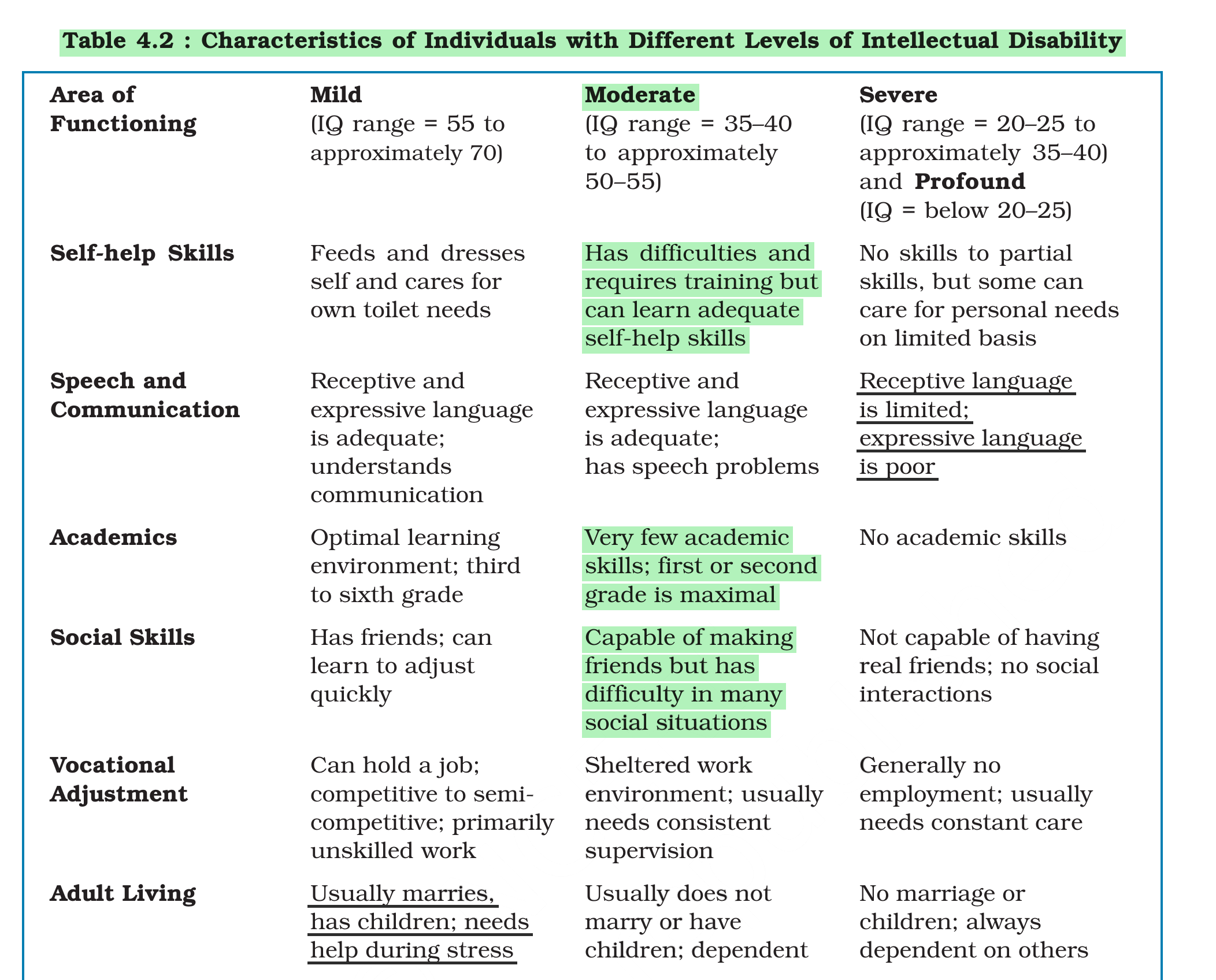
Individual with moderate level of intellectual disability shows following characteristics.
A. Has difficulties but can learn self help skills.
B. Receptive language is limited; expressive language is poor.
C. Very few academic skills, first or second grade is maximal.
D. Capable of making friends but has difficulty in social situations.
E. Usually marries and has children.
Choose the correct answer from the options given below:
Answer & explanation
Correct answer: option 1
The correct answer is Option (1) → A, C, D only
Intellectual disability is described level by level: mild (IQ 55 to about 70), moderate (IQ 35–40 to about 50–55), and severe and profound (IQ below 35–40). For each level the characteristics are given area by area: self-help skills, speech and communication, academics, social skills, vocational adjustment and adult living. The statements come from these descriptions.
A. Has difficulties but can learn self help skills. Correct. In self-help skills a person with moderate disability has difficulties and requires training but can learn adequate self-help skills.
B. Receptive language is limited; expressive language is poor. Incorrect. This is the speech and communication of the severe and profound levels. At the moderate level, receptive and expressive language is adequate, though the person has speech problems.
C. Very few academic skills, first or second grade is maximal. Correct. In academics, the moderate level has very few academic skills; first or second grade is maximal. A mildly disabled child can reach the third to sixth grade, while the severe level has no academic skills.
D. Capable of making friends but has difficulty in social situations. Correct. In social skills, the moderate level is capable of making friends but has difficulty in many social situations; at the severe level a person is not capable of having real friends.
E. Usually marries and has children. Incorrect. This is adult living at the mild level. A person with moderate disability usually does not marry or have children and remains dependent.
NCERT (2025-26): “Neurodevelopmental Disorders … Intellectual disability refers to below average intellectual functioning (with an IQ of approximately 70 or below), and deficits or impairments in adaptive behaviour (i.e. in the areas of communication, self-care, home living, social/interpersonal skills, functional academic skills, work, etc.) which are manifested before the age of 18 years. Table 4.2 describes characteristics of the intellectually disabled persons.”
|