
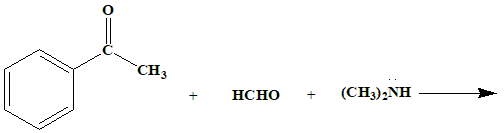
What is the product of the given reaction?
Answer & explanation
Correct answer: option 2
The correct answer is Option (2) → C6H5COCH2CH2N(CH3)2
A ketone with α-hydrogens, formaldehyde and a secondary amine react together in the Mannich reaction, which puts a \( \ce{CH2NR2} \) group on the α-carbon of the ketone. Formaldehyde and dimethylamine first form the iminium ion \( \ce{CH2=N^{+}(CH3)2} \); the enol of acetophenone then attacks its \( \ce{CH2} \) carbon:
HCHO + \( \ce{(CH3)2NH} \) + \( \ce{H^{+}} \) → \( \ce{CH2=N^{+}(CH3)2} \) + \( \ce{H2O} \)
\( \ce{C6H5COCH3} \) + \( \ce{CH2=N^{+}(CH3)2} \) → \( \ce{C6H5COCH2CH2N(CH3)2} \) + \( \ce{H^{+}} \)
The product is the β-amino ketone (Mannich base) 3-(dimethylamino)-1-phenylpropan-1-one, the structure in Option (2).
Why the other options are incorrect
Option (1) — Incorrect. It is the enol form of a different chain (\( \ce{C(OH)=CH-CH2N} \)); a simple enol is not the isolated product, the keto form is.
Option (3) — Incorrect. \( \ce{C6H5COCH2N(CH3)2} \) has only one carbon between C=O and N; the \( \ce{CH2} \) supplied by formaldehyde is missing.
Option (4) — Incorrect. It carries an ethyl group on nitrogen, which neither dimethylamine nor formaldehyde can supply, and it also lacks the \( \ce{CH2} \) from formaldehyde.
Note: The question is from beyond the NCERT textbook.