Read the text and answer the following questions
A person Y constantly complains of experiencing sudden intense fears. He says that many a times, these fears get at such a peak that he feels like he is going crazy, has shortness of breath, feels losing control or dying. Other clinical features reported are dizziness, trembling, palpitation, chest pain, choking and nausea. He was assured that he would recover, but he was unable to accept it, which caused more trouble for him. His family and friends got very concerned as his overall functioning in all the spheres of his life are being severely affected. While taking case history of person Y, it was found that his younger brother has difficulty being in a room by himself, going to school alone and clings to and shadows his parent’s every move.
Which disorder can he be diagnosed with on the basis of the reported symptoms?
Answer & explanation
Correct answer: option 1
The correct answer is Option (1) → Panic disorder
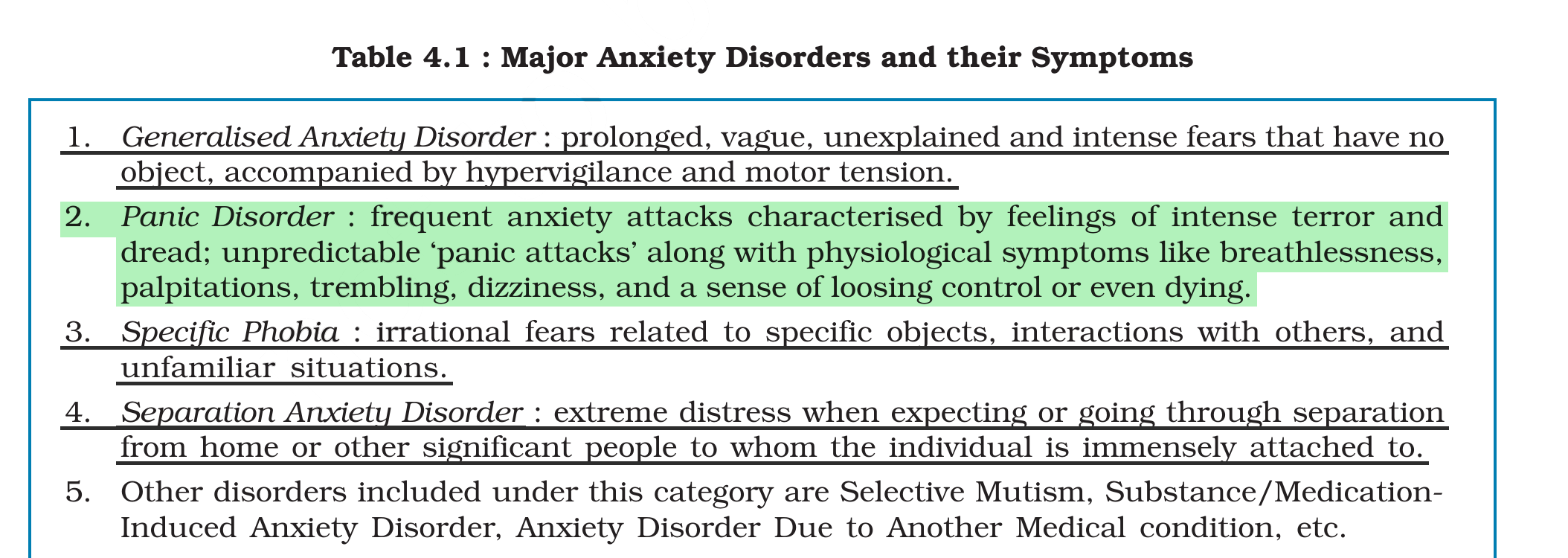
Option (1) Panic disorder — Correct. A panic attack is an abrupt surge of intense anxiety rising to a peak, and panic disorder is made of such recurrent attacks. Y’s ‘sudden intense fears’ reach ‘a peak’, and his features, shortness of breath, dizziness, trembling, palpitation, choking, nausea, chest pain, and the fear of going crazy, losing control or dying, are the clinical features of panic disorder one by one.
Option (2) Generalised anxiety disorder — Incorrect. It consists of prolonged, vague fears with worry about the future and constant motor tension. Y’s fears come in sudden attacks, not as a steady background worry.
Option (3) Separation anxiety disorder — Incorrect. It is fear of being separated from attachment figures. That fits Y’s younger brother, not Y.
Option (4) Phobia — Incorrect. A phobia is an irrational fear of a specific object, person or situation. Y’s fears are not tied to any object.
NCERT (2025-26): “Anxiety Disorders … There are many types of anxiety disorders (see Table 4.1). They include generalised anxiety disorder, which consists of prolonged, vague, unexplained and intense fears that are not attached to any particular object. The symptoms include worry and apprehensive feelings about the future; hypervigilance, which involves constantly scanning the environment for dangers. It is marked by motor tension, as a result of which the person is unable to relax, is restless, and visibly shaky and tense. Another type of anxiety disorder is panic disorder, which consists of recurrent anxiety attacks in which the person experiences intense terror. A panic attack denotes an abrupt surge of intense anxiety rising to a peak when thoughts of a particular stimuli are present. Such thoughts occur in an unpredictable manner. The clinical features include shortness of breath, dizziness, trembling, palpitations, choking, nausea, chest pain or discomfort, fear of going crazy, losing control or dying.…” “…People who have phobias have irrational fears related to specific objects, people, or situations.…” “…Separation anxiety disorder (SAD) is another type of anxiety disorder. Individuals with separation anxiety disorder are fearful and anxious about separation from attachment figures to an extent that is developmentally not appropriate.…”
|