
Question is based on following passage:
Methyl nitrile is hydrolysed to carboxylic acid in the presence of \(H^+\) or \(OH^-\) as catalyst. An intermediate compound [A] is formed during this reaction.
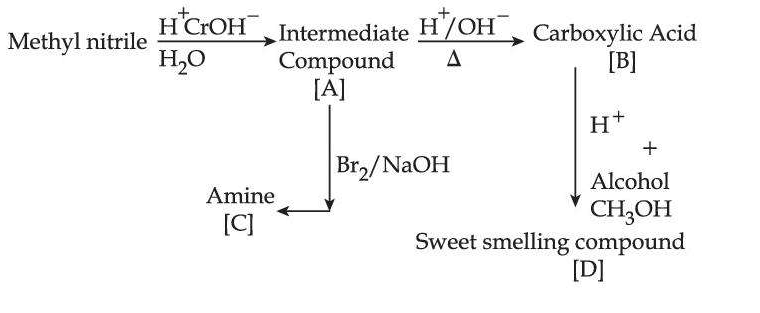
The intermediate compound [A] is:
Answer & explanation
Correct answer: option 3
The correct answer is Option (3) → Ethanamide
Methyl nitrile (ethanenitrile, \( \ce{CH3CN} \)) is hydrolysed in two stages; mild conditions stop the reaction at the amide:
\( \displaystyle \ce{CH3C#N + H2O} \xrightarrow[\text{mild}]{\ce{H+}\text{ or }\ce{OH-}} \underset{\text{[A], ethanamide}}{\ce{CH3CONH2}} \)
\( \displaystyle \ce{CH3CONH2 + H2O} \xrightarrow[\Delta]{\ce{H+}\text{ or }\ce{OH-}} \underset{\text{[B]}}{\ce{CH3COOH}} + \ce{NH3} \)
The amide keeps both carbon atoms of the nitrile, so [A] is ethanamide. The scheme also confirms it: [A] gives an amine [C] with \( \ce{Br2} \)/NaOH, a reaction of amides.
Why the other options are incorrect
Option (1) Methyl isocyanide — Incorrect. \( \ce{CH3NC} \) is an isomer of the nitrile, not a hydrolysis product; it is made by the carbylamine reaction.
Option (2) Ethyl amine — Incorrect. Ethylamine is obtained by reduction of the nitrile, not by hydrolysis:
\( \displaystyle \ce{CH3CN} \xrightarrow{\ce{Na(Hg)}/\ce{C2H5OH}} \ce{CH3CH2NH2} \)
Option (4) Methanamide — Incorrect. \( \ce{HCONH2} \) has only one carbon; hydrolysis does not remove a carbon atom from \( \ce{CH3CN} \).
NCERT (2026-27 edition):
From Nitriles and Amides
