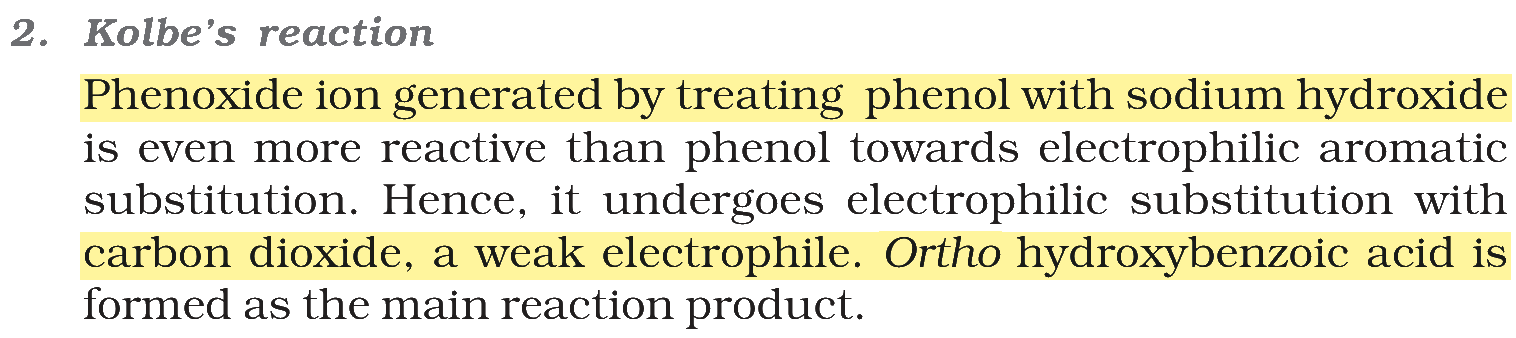
The reagents involved in the following conversion are
Answer & explanation
Correct answer: option 2
The correct answer is Option (2) → \(NaOH,CO_2, H^+\)
The conversion of phenol into salicylic acid (2-hydroxybenzoic acid) puts a –COOH group on the ring ortho to –OH. This is Kolbe’s reaction. Carbon dioxide is a weak electrophile, so the ring must first be made more reactive. Sodium hydroxide converts phenol into the phenoxide ion, which is even more reactive than phenol towards electrophilic substitution:
\( \displaystyle \ce{C6H5OH + NaOH -> C6H5O^-Na+ + H2O} \)
Sodium phenoxide is then heated with carbon dioxide under pressure (about 400 K, 4–7 atm), which substitutes mainly at the ortho position to give sodium salicylate. Acidification (\( \ce{H^{+}} \)) then sets free salicylic acid:
\( \displaystyle \ce{C6H5O^-Na+} \xrightarrow[\text{400 K, 4-7 atm}]{\ce{CO2}} o\text{-}\ce{HOC6H4COO^-Na+} \)
\( \displaystyle o\text{-}\ce{HOC6H4COO^-Na+} + \ce{H+} \longrightarrow o\text{-}\ce{HOC6H4COOH} + \ce{Na+} \)
So the reagents are NaOH, CO2 and H+, in that order.
Why the other options are incorrect
Option (1) \(CHCl_3, NaOH, H^+\) — Incorrect. These are the reagents of the Reimer-Tiemann reaction, which puts a –CHO group, not –COOH, at the ortho position and gives salicylaldehyde:
\( \displaystyle \ce{C6H5OH} \xrightarrow[\text{(ii) }\ce{H+}]{\text{(i) }\ce{CHCl3},\ \text{aq. NaOH}} o\text{-}\ce{HOC6H4CHO} \)
Option (3) \(CO_2, H^+,CHCl_3\) — Incorrect. Without alkali no phenoxide ion is formed, and phenol itself is not reactive enough to be attacked by the weak electrophile \( \ce{CO2} \); chloroform plays no part in carboxylation.
Option (4) \(H_2SO_4,CO_2, H^+\) — Incorrect. Sulphuric acid cannot form the phenoxide ion; concentrated \( \ce{H2SO4} \) would instead sulphonate the ring.
NCERT (2026-27 edition):
Kolbe’s Reaction