
A can do a piece of work in 15 days and B can do it in $22\frac{1}{2}$ days. They worked together for 6 days and the remaining work was completed by C alone in 6 days. A, B and C together will do the same work in:
Answer & explanation
Correct answer: option 3
A = 15 days, B = \( {22 }_{2 }^{1 } \) days,
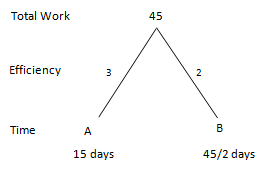
⇒ A + B worked for 6 days = (3 + 2) x 6 = 5 x 6 = 30 units,
⇒ Remaining work = 45 - 30 = 15 units,
⇒ Remaining work is completed by C in 6 days = \(\frac{15}{C}\) = 6 days,
⇒ C = \(\frac{15}{6}\) = \(\frac{5}{2}\), (Efficiency)
⇒ A + B + C = 3 + 2 + \(\frac{5}{2}\) = \(\frac{15}{2}\),
⇒ Time required by A + B + C to complete the total work = \(\frac{45}{15/2}\) = 6 days. ..(\(\frac{Work}{Efficiency}\) = Time)