Identify the chiral molecule from the following.
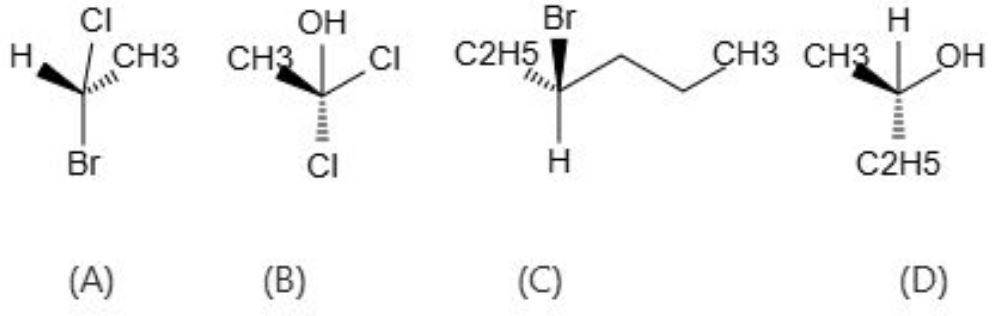
Choose the correct answer from the options given below:
Answer & explanation
Correct answer: option 1
The correct answer is Option (1) → (A), (C) and (D) only
A molecule is chiral when it cannot be superimposed on its mirror image. The common cause is a carbon atom bonded to four different groups (an asymmetric carbon or stereocentre). If two of the four groups on that carbon are the same, the molecule has a plane of symmetry and is achiral.
(A) — Correct. The central carbon carries H, Cl, \( \ce{CH3} \) and Br: four different groups, so 1-bromo-1-chloroethane is chiral.
(B) — Incorrect. The central carbon carries OH, \( \ce{CH3} \) and two Cl atoms. With two identical groups it is not a stereocentre, and the molecule is achiral.
(C) — Correct. The carbon carries Br, H, \( \ce{C2H5} \) and a \( \ce{CH2CH2CH3} \) chain (3-bromohexane). Ethyl and propyl are different groups, so all four are different and the molecule is chiral.
(D) — Correct. The carbon carries H, OH, \( \ce{CH3} \) and \( \ce{C2H5} \): this is butan-2-ol, a chiral molecule.
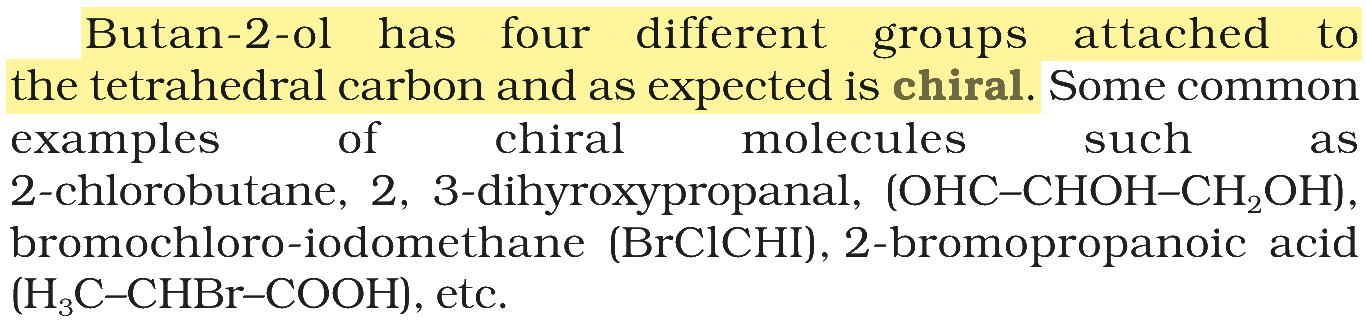
NCERT (2026-27 edition):
Reactions of Haloalkanes – …