Read the passage carefully and answer the questions based on the passage:
Macroeconomic Variables
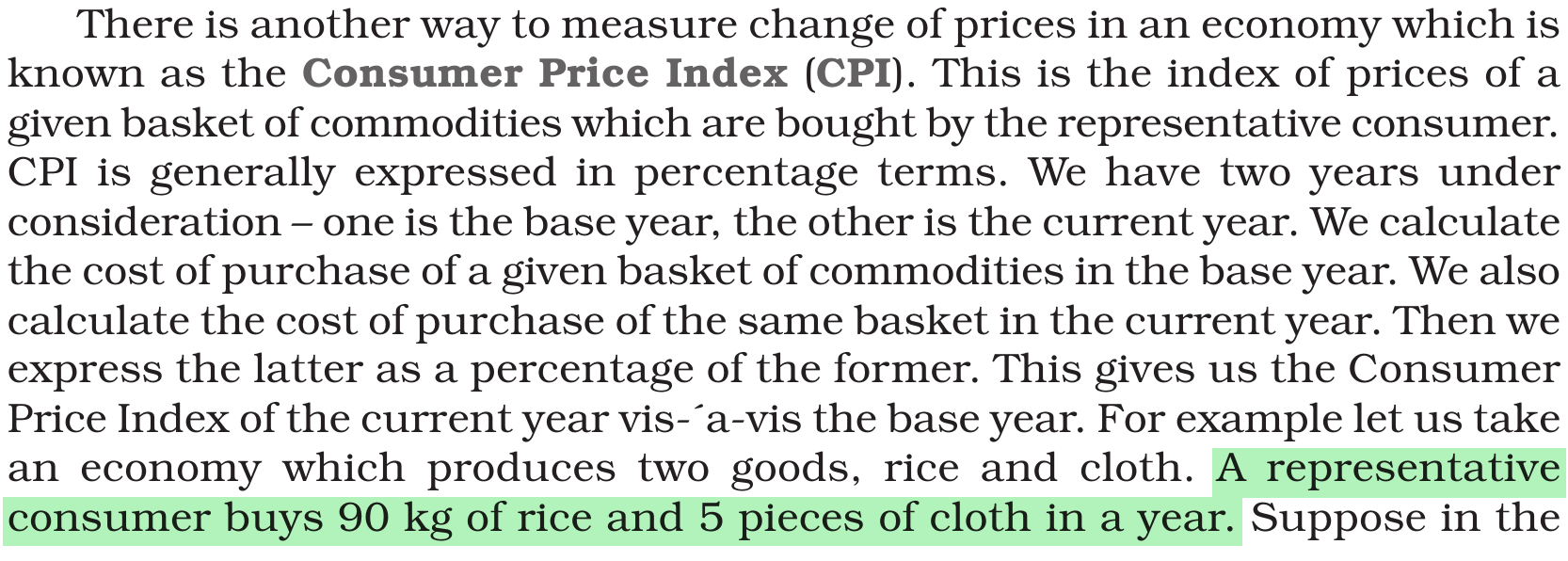
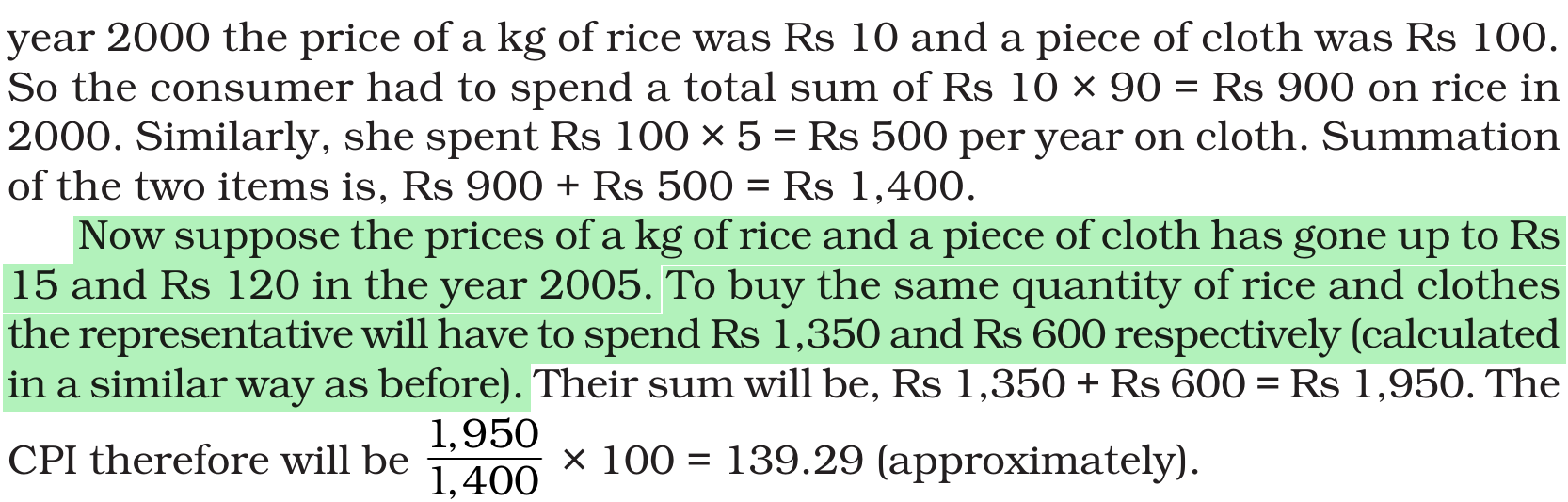
In an economy where two goods, wheat and cloth, are produced. A representative consumer buys 90 kg of wheat and 5 pieces of cloth in a year. Suppose in the year 2022 the price of a kg of wheat was Rs. 10 and a piece of cloth was Rs. 100. The prices of a kg of wheat and a piece of cloth went up to Rs. 15 and Rs. 120 respectively in the year 2025. It is worth noting that many commodities have two sets of prices. One is the retail price which the consumer actually pays. The other is the wholesale price, the price at which goods are traded in bulk. These two may differ in value because of the margin kept by traders.
The total sum that the consumer has to spend on wheat in 2025?
Answer & explanation
Correct answer: option 1
The correct answer is Option (1) → Rs 1,350
Given:
Quantity of wheat = 90 kg
Price of wheat in 2025 = Rs. 15 per kg
The sum spent on a good is its price multiplied by the quantity bought:
Sum spent on wheat = 15 × 90 = Rs 1,350
Note: The passage of this question is taken from the example on the Consumer Price Index in the chapter ‘National Income Accounting’ of the NCERT book (Introductory Macroeconomics). NTA has changed rice to wheat and the years to 2022 and 2025. The quantities and prices are the book’s. A small example in the book can turn into a whole set of questions, so solve such examples yourself.
NCERT (2026-27): Introductory Macroeconomics — Chapter 2: National Income Accounting
|