CUETMOCK
  • Pricing
  • Mentors
Log inStart freeStart free mocks→

First test, then trust

Try a free CUET mock test.

Join 5,00,000+ students who rehearsed exam day on the exact NTA screen before sitting CUET. On the web and on Android.

Start free mocks →Get the Android app
CUETMOCK

India's #1 CUET Mock Test Platform. Original NCERT-based questions on the exact NTA exam screen — trusted by 5,00,000+ students since CUET 2022.

Get it onGoogle PlayScan to download the CUETMOCK app

Mock tests

  • CUET mock test series
  • Browse all papers
  • Commerce mocks
  • Humanities (Arts) mocks
  • Science mocks
  • Languages & GAT mocks
  • Free practice questions
  • Pricing

Resources

  • CUET exam guide
  • CUET syllabus
  • Universities accepting CUET
  • Expert blogs
  • News & notifications
  • Webinars & counselling
  • CUET score calculator
  • How we estimate your rank
  • FAQs

Company

  • About us
  • Our leadership & team
  • Our toppers
  • Mentors
  • For schools
  • Contact us
  • Terms
  • Privacy
  • Refund policy

Talk to us

+91 7696 6630 56info@cuetmock.comWhatsApp us

Our other platforms

  • JEE Mock — For IIT-JEE aspirants
  • NEET Mock — For NEET aspirants

Newsletter

Exam updates, study material and offers — no spam.

© 2026 NYC Ventures Pvt. Ltd.

701-702, Royal Business Park, Zirakpur, Punjab - 140603

  • Terms of use
  • Privacy policy
  • Refund policy
  • Contact us

iCUETMOCK is an independent preparation platform, not affiliated with the National Testing Agency (NTA). Always check exam details on the official NTA website.

  • Home
  • Mock tests
  • CUET guide
  • Pricing
  • Log in
Home/Practice questions/Economics
EconomicsMicro Economics: Market Equilibrium

Consider a market consisting of identical farms producing the same qu…

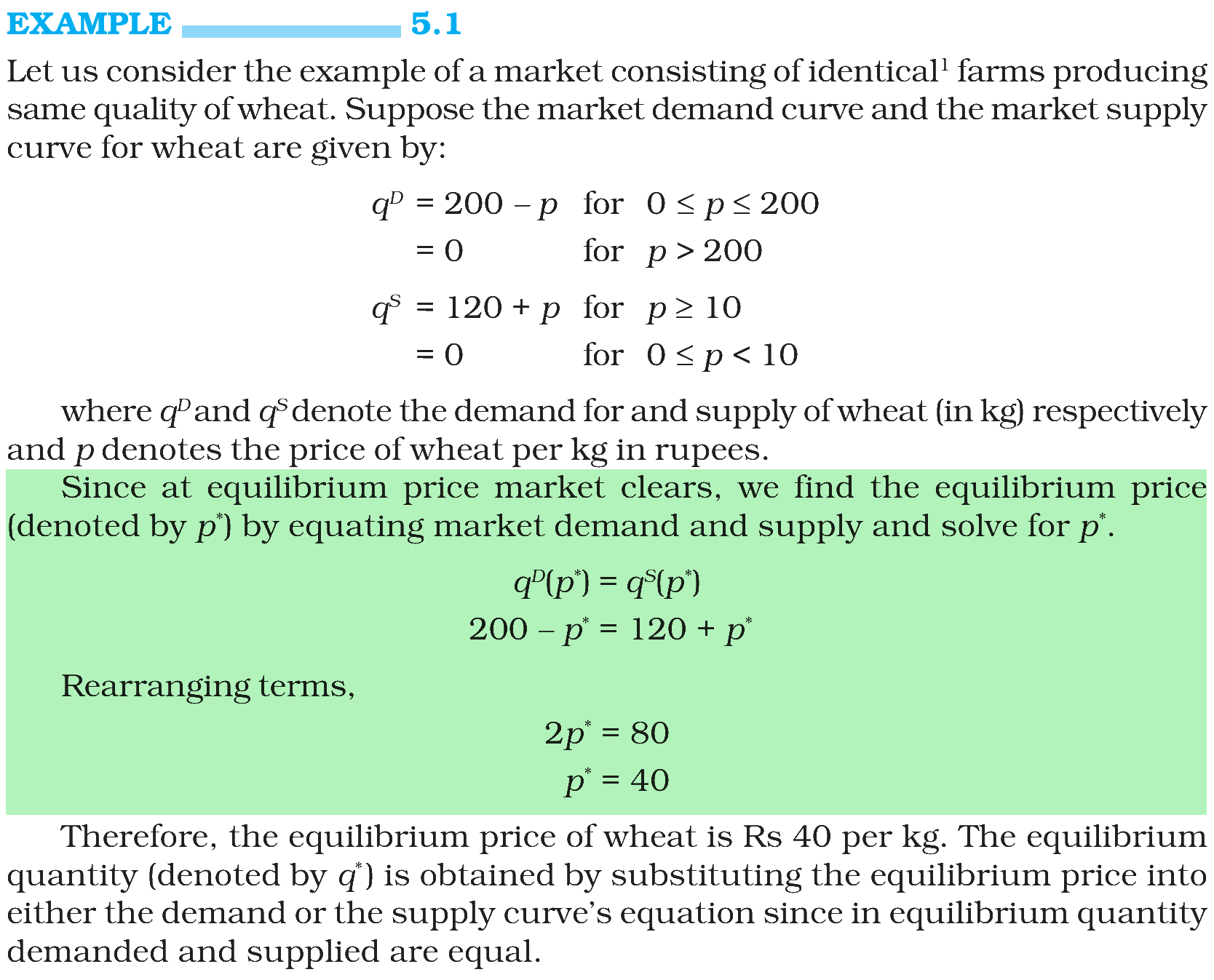
Consider a market consisting of identical farms producing the same quality of wheat. The market demand curve and the market supply curve for wheat are given by: 
qD = 250 - p for 0≤p≤250  

= 0 for p > 250 

qS = 150 + p for p ≥10 
= 0 for 0≤p<10 

What will be the equilibrium quantity? 

Answer & explanation+

Correct answer: option 2

The correct answer is Option (2) → 200

Given:

qD = 250 − p

qS = 150 + p

At equilibrium, market demand equals market supply. Find p* first, then put it into either curve.

    \( 250 - p = 150 + p \)

    \( 2p = 100 \)

    \( p^* = 50 \)

    \( q^* = 250 - 50 = 200 \)

Check with supply: 150 + 50 = 200. The equilibrium quantity is 200.

NCERT (2026-27): NCERT extract

NCERT extract

Advertisement

Practise more on Micro Economics: Market Equilibrium

Chapter-wise mocks on the real NTA exam screen, with solutions and your rank. Your first mocks are free.

Start free mocks →

Advertisement

Next questions

  1. Match the column 1 with column 2 : COLUMN 1 COLUMN 2 A. Out-crossing i. Mating of closely related individuals within the same breed B. Inte…Biology · Strategies for enhancement in Food production
  2. In which year was "Task Force on Projections of Minimum Needs and Effective Consumption Demand" was formed?Economics · Indian Economic Development: Poverty
  3. What is the total revenue from operations?Accountancy Part B · Accounting Ratios
  4. The mode of the following data is 36. What is the value of x ? Class 0-10 10-20 20-30 30-40 40-50 50-60 Frequency 13 10 10 16 x 8General Aptitude Test · Quantitative Reasoning
  5. If the length of a rectangle is decreased by 16 2/3 % and breadth is increased by 9 1/11 %. What's the effect on area?General Aptitude Test · Quantitative Reasoning
  6. Consider the following statements about changing the galvanometer into a voltmeter:(A) The voltmeter is connected in series with the resist…Physics · Moving Charges and Magnetism
  7. The electoral college to elect the President of India consists of which of the following?(A) Members of Lok Sabha(B) Members of Municipal C…General Aptitude Test · General Knowledge
  8. The rate of increase of length of the shadow of a man 2 metres height, due to a lamp at 10 metres height, when he is moving away from it at…Maths. Section B1 · Applications of Derivatives
  9. Colour blindness is a:Biology · Principles of Inheritance and Variation
  10. Diamond is the purest form of ________.General Aptitude Test · General Knowledge