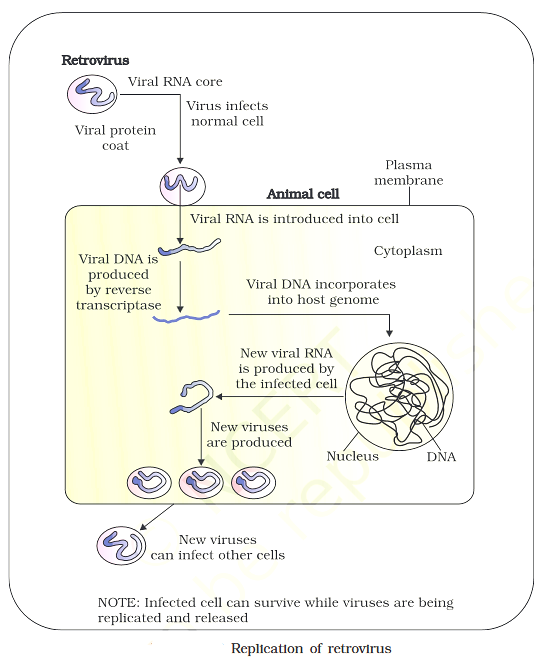
Steps of replication of retrovirus (HIV) in the host cell are given below. Arrange the steps in correct sequence.
(A) Viral RNA is introduced in host cell
(B) New viruses with new RNA are produced
(C) Viral DNA is produced by reverse transcription
(D) Viral DNA incorporates into host genome
(E) Virus infects the normal cell
Choose the correct answer from the options given below:
Answer & explanation
Correct answer: option 1
The correct answer is Option (1) → (E), (A), (C), (D), (B)
(E) Virus infects the normal cell
(A) Viral RNA is introduced in host cell
(C) Viral DNA is produced by reverse transcription
(D) Viral DNA incorporates into host genome
(B) New viruses with new RNA are produced
After getting into the body of the person, the virus enters into macrophages where RNA genome of the virus replicates to form viral DNA with the help of the enzyme reverse transcriptase. This viral DNA gets incorporated into host cell’s DNA and directs the infected cells to produce virus particles . The macrophages continue to produce virus and in this way acts like a HIV factory. Simultaneously, HIV enters into helper T-lymphocytes (TH), replicates and produce progeny viruses. The progeny viruses released in the blood attack other helper T-lymphocytes. This is repeated leading to a progressive decrease in the number of helper T-lymphocytes in the body of the infected person. During this period, the person suffers from bouts of fever, diarrhoea and weight loss. Due to decrease in the number of helper T lymphocytes, the person starts suffering from infections that could have been otherwise overcome such as those due to bacteria especially Mycobacterium, viruses, fungi and even parasites like Toxoplasma. The patient becomes so immuno-deficient that he/she is unable to protect himself/herself against these infections. A widely used diagnostic test for AIDS is enzyme linked immuno-sorbent assay (ELISA). Treatment of AIDS with anti-retroviral drugs is only partially effective. They can only prolong the life of the patient but cannot prevent death, which is inevitable.