Which of the following 3d series element will have highest melting point?
Answer & explanation
Correct answer: option 2
The correct answer is Option (2) → Chromium
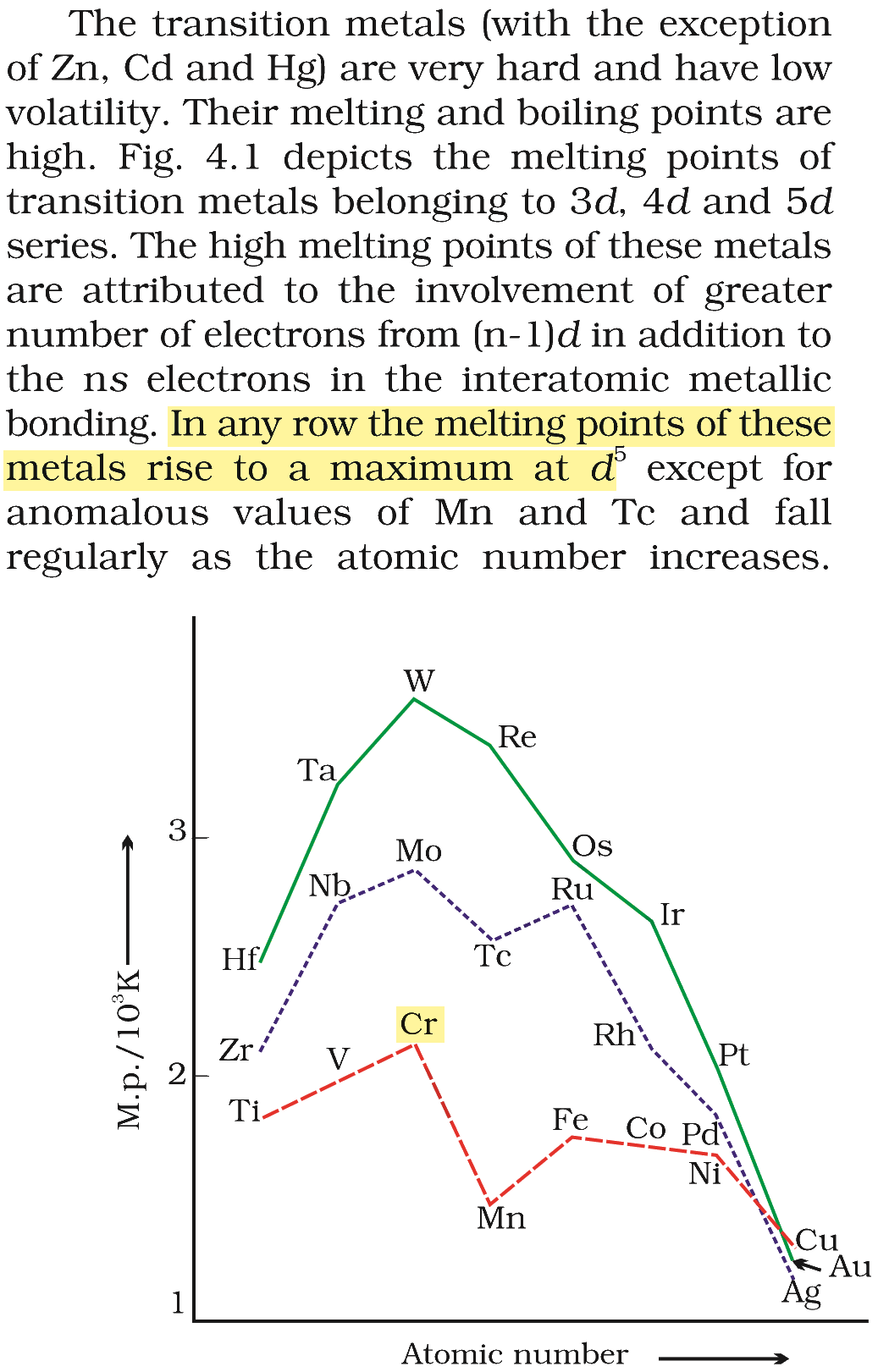
Transition metals have high melting points because of strong metallic bonding, in which the unpaired (n−1)d electrons also take part along with the ns electrons. The more unpaired d electrons, the stronger the bonding. So across the 3d series the melting point rises to a maximum near d5 and then falls as the d electrons pair up.
Chromium, Cr (Z = 24), is [Ar]3d54s1: all six valence electrons are unpaired, so its metallic bonding is very strong. The melting points of the given metals are:
Cr 2180 K > Ti 1941 K > Fe 1811 K > Mn 1519 K
So among the given elements chromium has the highest melting point.
Why the other options are incorrect
Option (1) Manganese — Incorrect. Mn (Z = 25, [Ar]3d54s2) has an unusually low melting point; its stable half-filled 3d5 electrons are held firmly and take less part in metallic bonding.
Option (3) Titanium — Incorrect. Ti (Z = 22, [Ar]3d24s2) has only two d electrons, so fewer electrons take part in bonding.
Option (4) Iron — Incorrect. Fe (Z = 26, [Ar]3d64s2) has begun to pair its d electrons (4 unpaired), so its bonding is weaker than that of Cr.
NCERT (2026-27 edition):
Physical Properties – …