Identify the correct sequence of steps involved in the process of planning.
A. Ideal plan having least negative consequences to be selected
B. Specifying quantitative goals to be achieved by the organization
C. Weighing the pros and cons of each alternative course
D. Forecasting based on assumptions relating to the future
E. Identifying all the alternative courses of action available
Choose the correct answer from the options given below:
Answer & explanation
Correct answer: option 4
The correct answer is Option (4) → B, D, E, C, A
B. Specifying quantitative goals to be achieved by the organization — Step 1. Setting objectives is the first and foremost step. The objectives are what the organisation wants to achieve, for example a 20% rise in sales.
D. Forecasting based on assumptions relating to the future — Step 2. Developing premises comes next. Forecasts about demand, interest rates and tax rates give the assumptions.
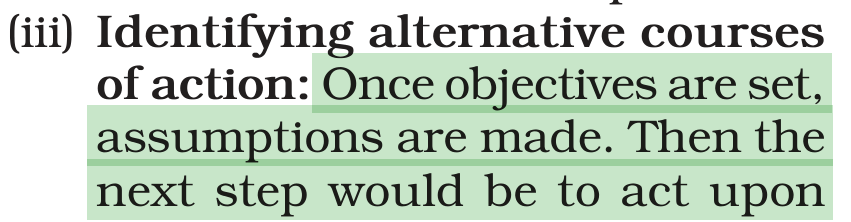
E. Identifying all the alternative courses of action available — Step 3. Once objectives are set and assumptions are made, all the possible courses of action are identified.
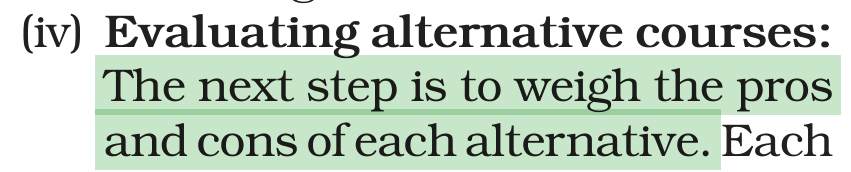
C. Weighing the pros and cons of each alternative course — Step 4. Each alternative is evaluated for its positive and negative aspects.
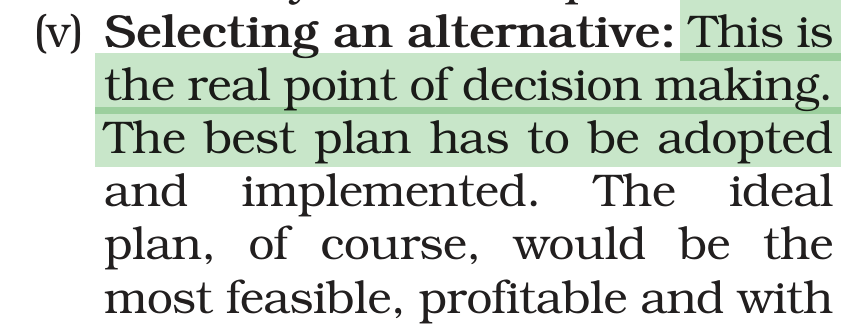
A. Ideal plan having least negative consequences to be selected — Step 5. The best plan is selected last. It should be the most feasible, profitable and with the least negative consequences.
NCERT (2026-27 Edition): “Planning Process … (i) Setting Objectives: The first and foremost step is setting objectives. Every organisation must have certain objectives. Objectives may be set for the entire organisation and each department or unit within the organisation. Objectives or goals specify what the organisation wants to achieve. It could mean an increase in sales by 20% which could be objective of the entire organisation. …” “(ii) Developing Premises: Planning is concerned with the future which is uncertain and every planner is using conjecture about what might happen in future.”
|