
Statement I: pBR322 is a cloning vector of the yeast Saccharomyces cerevisiae.
Statement II: In the vector pBR322, rop codes for the proteins involved in the replication of the plasmid.
Answer & explanation
Correct answer: option 2
The correct answer is Option (2) → Only Statement II is correct.
Statement I: pBR322 is a cloning vector of the yeast Saccharomyces cerevisiae. — False. pBR322 is an E. coli cloning vector. Its selectable markers, the genes for ampicillin and tetracycline resistance, are useful in E. coli because normal E. coli cells are not resistant to these antibiotics.
Statement II: In the vector pBR322, rop codes for the proteins involved in the replication of the plasmid. — True. Besides ori, ampR and tetR, the map of pBR322 shows rop, which codes for the proteins involved in the replication of the plasmid.
Note: Search the running text of the chapter for rop and you come back empty-handed; its one line hides under Figure 9.4. Captions are where the book keeps its spare facts, so read them along with the paragraphs.
NCERT Extract:
Cloning Vectors – “… Normally, the genes encoding resistance to antibiotics such as ampicillin, chloramphenicol, tetracycline or kanamycin, etc., are considered useful selectable markers for E. coli. The normal E. coli cells do not carry resistance against any of these antibiotics.”
Cloning Vectors – “… The ligation of alien DNA is carried out at a restriction site present in one of the two antibiotic resistance genes. For example, you can ligate a foreign DNA at the BamH I site of tetracycline resistance gene in the vector pBR322.”
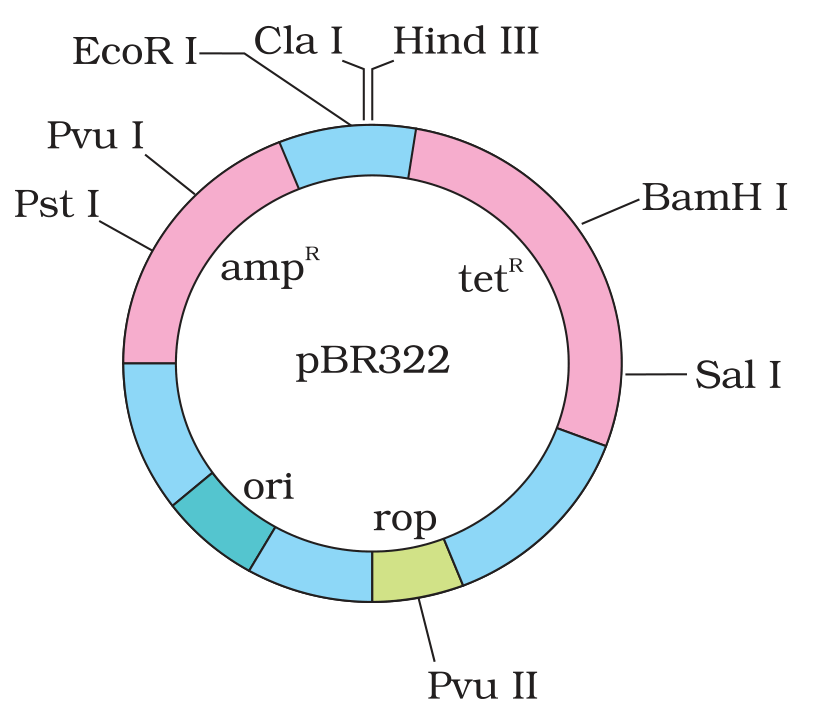
Figure 9.4 E. coli cloning vector pBR322 showing restriction sites (Hind III, EcoR I, BamH I, Sal I, Pvu II, Pst I, Cla I), ori and antibiotic resistance genes (ampR and tetR). rop codes for the proteins involved in the replication of the plasmid