CUETMOCK
  • Pricing
  • Mentors
Log inStart freeStart free mocks→

First test, then trust

Try a free CUET mock test.

Join 5,00,000+ students who rehearsed exam day on the exact NTA screen before sitting CUET. On the web and on Android.

Start free mocks →Get the Android app
CUETMOCK

India's #1 CUET Mock Test Platform. Original NCERT-based questions on the exact NTA exam screen — trusted by 5,00,000+ students since CUET 2022.

Get it onGoogle PlayScan to download the CUETMOCK app

Mock tests

  • CUET mock test series
  • Browse all papers
  • Commerce mocks
  • Humanities (Arts) mocks
  • Science mocks
  • Languages & GAT mocks
  • Free practice questions
  • Pricing

Resources

  • CUET exam guide
  • CUET syllabus
  • Universities accepting CUET
  • Expert blogs
  • News & notifications
  • Webinars & counselling
  • CUET score calculator
  • How we estimate your rank
  • FAQs

Company

  • About us
  • Our leadership & team
  • Our toppers
  • Mentors
  • For schools
  • Contact us
  • Terms
  • Privacy
  • Refund policy

Talk to us

+91 7696 6630 56info@cuetmock.comWhatsApp us

Our other platforms

  • JEE Mock — For IIT-JEE aspirants
  • NEET Mock — For NEET aspirants

Newsletter

Exam updates, study material and offers — no spam.

© 2026 NYC Ventures Pvt. Ltd.

701-702, Royal Business Park, Zirakpur, Punjab - 140603

  • Terms of use
  • Privacy policy
  • Refund policy
  • Contact us

iCUETMOCK is an independent preparation platform, not affiliated with the National Testing Agency (NTA). Always check exam details on the official NTA website.

  • Home
  • Mock tests
  • CUET guide
  • Pricing
  • Log in
Home/Practice questions/Economics
EconomicsMicro Economics: Market Equilibrium

Which of the following statement/statements are true? Statement I: Wh…

Which of the following statement/statements are true?
Statement I: When increase in demand is less than decrease in supply, rightward shift in demand will be more than leftward shift in supply.
Statement II: When increase in demand is less than decrease in supply, equilibrium quantity falls.

Answer & explanation+

Correct answer: option 4

The correct answer is Option (4) → Statement II is true and Statement I is false.

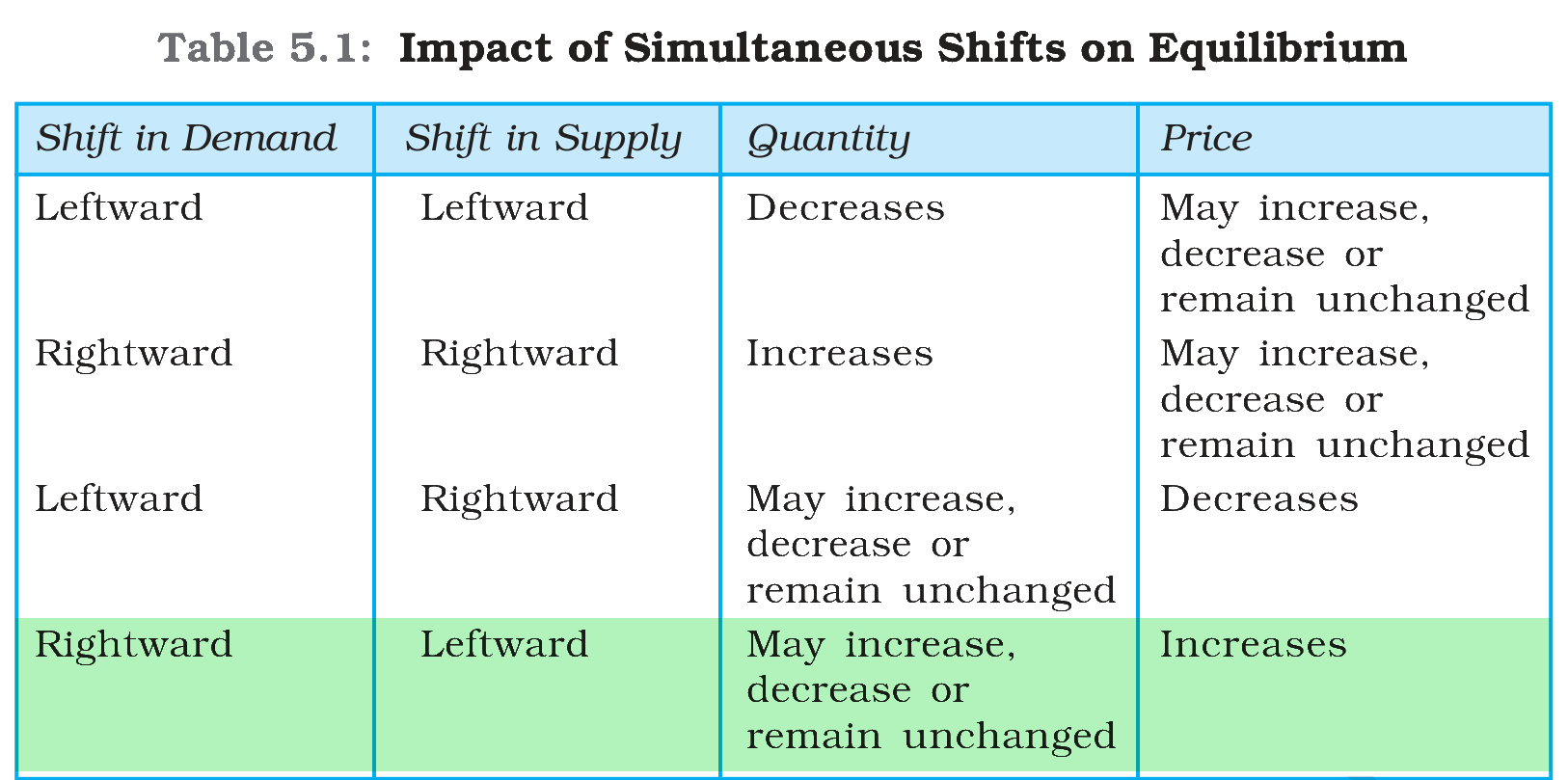
Demand shifts right and supply shifts left, so the price rises for certain. The quantity follows the bigger shift.

Statement I: When increase in demand is less than decrease in supply, rightward shift in demand will be more than leftward shift in supply. — False. Demand rises by less than supply falls, so the rightward shift of demand is smaller than the leftward shift of supply.

Statement II: When increase in demand is less than decrease in supply, equilibrium quantity falls. — True. The fall in supply is bigger than the rise in demand, so less is bought and sold.

Note: NTA uses the terms ‘increase in demand’ and ‘decrease in supply’; NCERT describes these as a rightward shift of the demand curve and a leftward shift of the supply curve.

NCERT (2026-27): “Simultaneous Shifts of Demand and Supply … In the first two cases which are shown in the first two rows of the table, the impact on equilibrium quantity is unambiguous but the equilibrium price may change, if at all, in either direction depending on the magnitudes of shifts. In the next two cases, shown in the last two rows of the table, the effect on price is unambiguous whereas effect on quantity depends on the magnitude of shifts in the two curves.”

NCERT extract

Advertisement

Practise more on Micro Economics: Market Equilibrium

Chapter-wise mocks on the real NTA exam screen, with solutions and your rank. Your first mocks are free.

Start free mocks →

Advertisement

Next questions

  1. Choose the most appropriate meaning of the idiom given below from the options:- She stood by him through thick and thin.English · Grammar: Idioms
  2. Let a , b & c be three vectors such that |a|=3 , |b|=4 , |c|=5 and each one of them being perpendicular to the sum of the other two, find |…Maths. Section B1 · Vectors
  3. Sanskritization as a concept has been criticised as : (A) It does not lead to structural change in society (B) It results in positional cha…Sociology · Social Change and Development in India: Cultural Change
  4. सूची -I को सूची -II से सुमेलित कीजिए :सूची -I शब्दसूची -II प्रत्ययA. उच्चतरI. आलुB. अधिकतमII. तमC. श्रद्धालुIII. इतD. हर्षितIV. तरनीचे दिए…Hindi · प्रत्यय
  5. If the equation of a demand curve takes the form pq = e, where e is constant. If expenditure is always same and equals to e, then the deman…Economics · Micro Economics: Theory of Consumer behaviour
  6. Each method in List-I gives an intermediate, which is hydrolysed to an aldehyde. Match List-I (method) with List-II (intermediate).List-I(M…Chemistry · Organic: Aldehydes, Ketones and Carboxylic Acids
  7. By using what can the colloidal particles can be separated from particles of true solution?Chemistry · Physical: Surface Chemistry
  8. What was the purpose of Sahibdin’s oblique aerial perspective in the ‘Yuddha Kanda’ of the ‘Ramayana’?Fine Arts · The Rajasthani Schools of Painting
  9. A rectangular park is 45 m long and 30 m wide. A 2.5 m wide path is constructed all along outside the park. The area of the path is :General Aptitude Test · Quantitative Reasoning
  10. The primary aim of financial management is:Business Studies · Financial Management