
PQR is a triangle. The bisectors of the internal angle \(\angle Q\) and external angle \(\angle R\) intersect at M. If \(\angle QMR=40^\circ\), then \(\angle P\) is:
Answer & explanation
Correct answer: option 4
The correct answer is Option (4) → 80°
The exterior angle of a triangle equals the sum of the two opposite interior angles. Produce QR to S, so that the exterior angle at R is \(\angle PRS\). Let the bisector QM cut \(\angle Q\) into two angles \(y\), and the bisector RM cut \(\angle PRS\) into two angles \(x\).
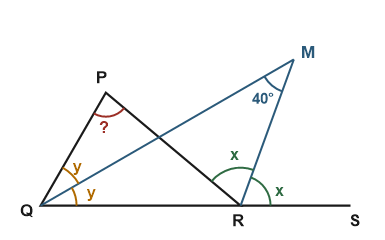
In triangle QMR (\(\angle MRS\) is its exterior angle):
\(x=y+\angle QMR=y+40^\circ\) (1)
In triangle PQR (\(\angle PRS\) is its exterior angle):
\(2x=\angle P+2y\) (2)
Finding \(\angle P\) (doubling (1) and putting it into (2), the \(2y\) terms cancel):
\(2y+80^\circ=\angle P+2y\)
\(\angle P=80^\circ\)
Tip: The bisectors of an interior angle and an exterior angle of a triangle always meet at half the third angle: \(\angle QMR=\frac{1}{2}\angle P\). Here \(\angle P=2\times40^\circ=80^\circ\).