
CUETMOCK
  • Pricing
  • Mentors
Log inStart freeStart free mocks→

First test, then trust

Try a free CUET mock test.

Join 5,00,000+ students who rehearsed exam day on the exact NTA screen before sitting CUET. On the web and on Android.

Start free mocks →Get the Android app
CUETMOCK

India's #1 CUET Mock Test Platform. Original NCERT-based questions on the exact NTA exam screen — trusted by 5,00,000+ students since CUET 2022.

Get it onGoogle PlayScan to download the CUETMOCK app

Mock tests

  • CUET mock test series
  • Browse all papers
  • Commerce mocks
  • Humanities (Arts) mocks
  • Science mocks
  • Languages & GAT mocks
  • Free practice questions
  • Pricing

Resources

  • CUET exam guide
  • CUET syllabus
  • Universities accepting CUET
  • Expert blogs
  • News & notifications
  • Webinars & counselling
  • CUET score calculator
  • How we estimate your rank
  • FAQs

Company

  • About us
  • Our leadership & team
  • Our toppers
  • Mentors
  • For schools
  • Contact us
  • Terms
  • Privacy
  • Refund policy

Talk to us

+91 7696 6630 56info@cuetmock.comWhatsApp us

Our other platforms

  • JEE Mock — For IIT-JEE aspirants
  • NEET Mock — For NEET aspirants

Newsletter

Exam updates, study material and offers — no spam.

© 2026 NYC Ventures Pvt. Ltd.

701-702, Royal Business Park, Zirakpur, Punjab - 140603

  • Terms of use
  • Privacy policy
  • Refund policy
  • Contact us

iCUETMOCK is an independent preparation platform, not affiliated with the National Testing Agency (NTA). Always check exam details on the official NTA website.

  • Home
  • Mock tests
  • CUET guide
  • Pricing
  • Log in
Home/Practice questions/Maths. Section B1
Maths. Section B1Applications of Derivatives

The function f(x) = cos x is strictly decreasing in:

The function f(x) = cos x is strictly decreasing in:

Answer & explanation+

Correct answer: option 4

The correct answer is Option (4) → \((0, \pi)\)

f is strictly decreasing where f’(x) < 0.

    \(f'(x) = -\sin x\)

For 0 < x < π, sin x > 0, so f’(x) < 0 and cos x is strictly decreasing on (0, π).

For π < x < 2π, sin x < 0, so f’(x) > 0 and cos x is increasing there. This rules out every interval that goes beyond π: \(\left(\frac{\pi}{2}, \frac{3\pi}{2}\right)\), (0, 2π) and (π, 2π).

NCERT (2026-27 edition):
Increasing and Decreasing Functions
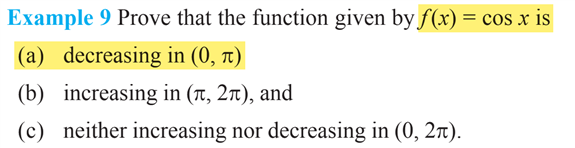
NCERT extract

Advertisement

Practise more on Applications of Derivatives

Chapter-wise mocks on the real NTA exam screen, with solutions and your rank. Your first mocks are free.

Start free mocks →

Advertisement

Next questions

  1. If tan3θ.tan7θ= 1, where 7θ is an acute angle, then find the value of cot15θ.General Aptitude Test · Quantitative Reasoning
  2. Find the sum of money which when increased by 15% becomes ₹19,320.General Aptitude Test · Numerical Ability
  3. Under whose leadership was the Group 1890 formed?Fine Arts · The Modern Indian Art
  4. Select the answer figure in which the question figure is embedded. (Rotation is not allowed)General Aptitude Test · Verbal Reasoning
  5. In the Geiger-Marsden experiment, the distance of closest approach of a 5.5 MeV α -particle to a gold nucleus ^197_79Au is about 4.0×10^-14…Physics · Nuclei
  6. 'सन्निहित' का संधि विच्छेद है -Hindi · व्याकरण - सन्धि
  7. Pankaj is younger than Sonali and Rupali is older than Tinu. Who among them is oldest?Statements:A. Rupali is older than Pankaj.B. Sonali i…General Aptitude Test · Verbal Reasoning
  8. Arrange the following words in the order in which they appear in an English dictionary. 1. General 2. Gender 3. Gasket 4. Genial 5. GatherGeneral Aptitude Test · Verbal Reasoning
  9. The domain of the function cos^-1(2x - 1) isMaths. Section B1 · Inverse Trigonometric Functions
  10. What is the depth of the Suez Canal ?Geography · Fundamentals of Human Geography: Transport and Communication