Read the following text and answer the question.
Mr. Yash Mittal is running a successful business. He is the owner of Y. K. Cement Ltd. Mr. Mittal decided to expand his business by acquiring a steel factory. This required an investment of Rs. 60 crores. To seek advice in this matter, he called his financial advisor, Mr. Amit Pathak, who advised him to have a judicious mix of equity (40%) and debt (60%). He suggested that employing more of cheaper debt may enhance the EPS. Mr. Pathak also suggested that he take a loan from a financial institution, as the cost of raising funds from financial institutions is low. This will increase the financial risk, but it will also raise the return to equity shareholders. He also told him that issue of debt will not dilute the control of equity shareholders. At the same time, the interest on the loan is a tax-deductible expense for computation of tax liability. After due deliberations with Mr. Pathak, Mr. Mittal decided to raise funds from a financial institution.
Mr. Pathak suggested that employing more of cheaper debt may enhance the EPS. This practice is called:
Answer & explanation
Correct answer: option 3
The correct answer is Option (3) → Trading on Equity
Option (1) Financial Leverage — Incorrect. Financial leverage is the proportion of debt in the overall capital. It only measures how much debt is used. It is not the name of the practice of using more cheap debt to raise the EPS.
Option (2) Capital Structure — Incorrect. Capital structure is the mix of owners' funds and borrowed funds. It is the result of the financing decision, not the name of the practice of using cheap debt to lift EPS.
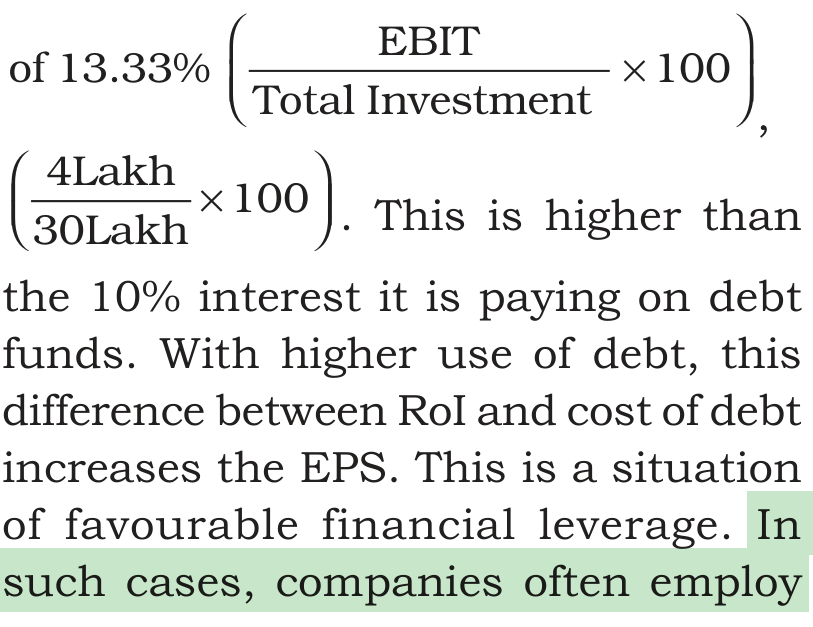
Option (3) Trading on Equity — Correct. When the return on investment is higher than the cost of debt, more debt raises the EPS. Using more of cheaper debt to enhance the EPS is called trading on equity.
Option (4) Capital Budgeting — Incorrect. Capital budgeting is the decision to invest funds in long-term assets such as plant and machinery. It is about where funds are invested.
NCERT (2026-27 Edition): “Capital Structure … Capital structure of a company, thus, affects both the profitability and the financial risk. A capital structure will be said to be optimal when the proportion of debt and equity is such that it results in an increase in the value of the equity share. In other words, all decisions relating to capital structure should emphasise on increasing the shareholders’ wealth. The proportion of debt in the overall capital is also called financial leverage. …” “EBIT-EPS Analysis … The company earns Rs. 0.93 per share if it is unlevered. With debt of Rs. 10 lakh its EPS is Rs. 1.05. With a still higher debt of Rs. 20 lakh, its, EPS rises to Rs. 1.40. Why is the EPS rising with higher debt? It is because the cost of debt is lower than the return that company is earning on funds employed. The company is earning a Return on Investment (RoI)”
“… more of cheaper debt to enhance the EPS. Such practice is called Trading on Equity. …” |