
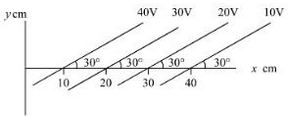
Some equipotential surfaces are shown. What is the magnitude and direction of electric field?
Answer & explanation
Correct answer: option 3
The correct answer is Option (3) → 200 V/m making an angle of 300° with x-axis
The electric field is perpendicular to the equipotential surfaces and points towards decreasing potential. Its magnitude is the potential difference divided by the perpendicular distance between two surfaces.
Readings from the figure:
\( \text{surfaces at } 30^\circ \text{ to the } x\text{-axis} \)
\( \text{spacing along } x = 10\,\mathrm{cm} \)
\( \text{potential difference} = 10\,\mathrm{V} \)
\( V \text{ falls from } 40\,\mathrm{V} \text{ to } 10\,\mathrm{V} \text{ as } x \text{ increases} \)
The perpendicular distance between two neighbouring surfaces is
\( \displaystyle d = 10\sin 30^\circ = 5\,\mathrm{cm} = 0.05\,\mathrm{m} \)
\( \displaystyle E = \frac{\Delta V}{d} = \frac{10\,\mathrm{V}}{0.05\,\mathrm{m}} = 200\,\mathrm{V/m} \)
The surfaces make \( 30^\circ \) with the \( x \)-axis, so the normal to them is at \( 30^\circ + 90^\circ = 120^\circ \) or at \( 30^\circ - 90^\circ = -60^\circ \). The potential falls as \( x \) increases, so the field must have a component along \( +x \). Of the two normals, only \( -60^\circ \) has this.
\( \displaystyle \text{direction} = -60^\circ = 300^\circ \text{ with the } x\text{-axis} \)