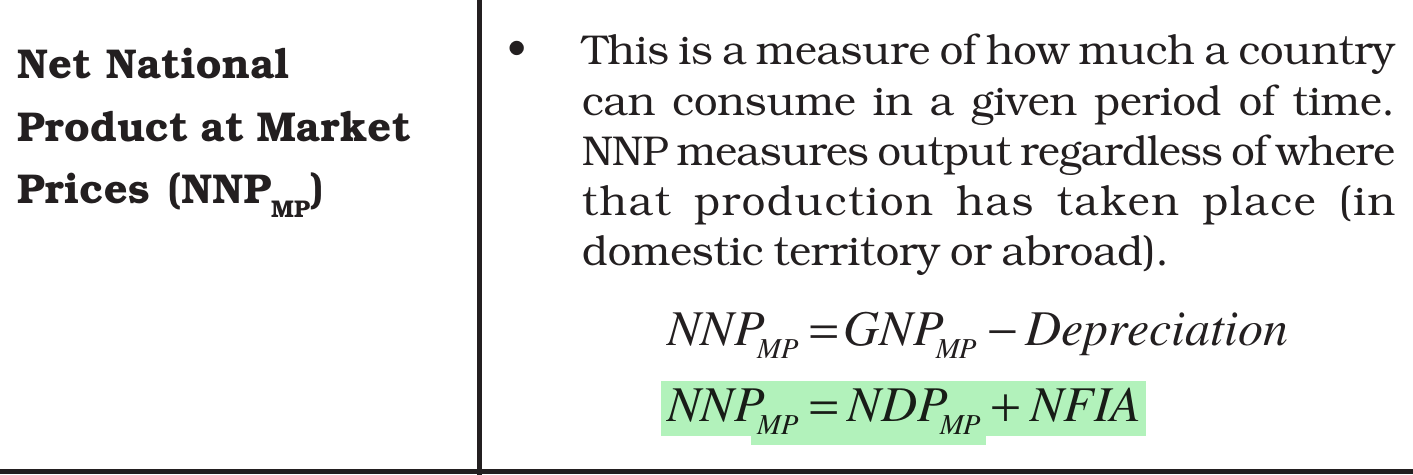
Arrange the steps to calculate Net National Product at market Price by Income Method.
(A) Identify and add factor Income (Rent, wages, interest and profit).
(B) Add Net factor income from abroad.
(C) Add Net Indirect Taxes.
(D) Add mixed income of self-employed.
Choose the correct answer from the options given below:
Answer & explanation
Correct answer: option 2
The correct answer is Option (2) → (A), (D), (C), (B)
The income method adds the incomes earned in production within the country. Then it moves to market prices, and from the domestic level to the national level. In this order, each step ends in a named measure:
(A) Identify and add factor Income (Rent, wages, interest and profit). — The method starts with the incomes paid to the factors of production.
(D) Add mixed income of self-employed. — Self-employed people earn a mix of wages, rent and profit from their own work. Adding this gives Net Domestic Product at factor cost (NDPFC).
(C) Add Net Indirect Taxes. — Market prices include indirect taxes minus subsidies. Adding them gives Net Domestic Product at market price (NDPMP).
(B) Add Net factor income from abroad. — This adds what residents earn abroad, less what non-residents earn here. It gives Net National Product at market price (NNPMP).
Note: The term mixed income is not in any of the NCERT books (2026-27, 2025-26, 2023-24 or pre-rationalised). Their income method adds only wages, profits, rent and interest. Mixed income is the usual name in national accounts for what the self-employed earn.
NCERT (2026-27): “2.2.3 Income Method As we mentioned in the beginning, the sum of final expenditures in the economy must be equal to the incomes received by all the factors of production taken together (final expenditure is the spending on final goods, it does not include spending on intermediate goods). This follows from the simple idea that the revenues earned by all the firms put together must be distributed among the factors of production as salaries, wages, profits, interest earnings and rents.… 2.3 Some Macroeconomic Identities … It is to be noted that all these variables are evaluated at market prices. Through the expression given above, we get the value of NNP evaluated at market prices. But market price includes indirect taxes. When indirect taxes are imposed on goods and services, their prices go up. Indirect taxes accrue to the government. We have to deduct them from NNP evaluated at market prices in order to calculate that part of NNP which actually accrues to the factors of production. Similarly, there may be subsidies granted by the government on the prices of some commodities (in India petrol is heavily taxed by the government, whereas cooking gas is subsidised). So we need to add subsidies to the NNP evaluated at market prices.…” Table 2.4: Basic National Income Aggregates
|