Find the incorrect option from the following?
Answer & explanation
Correct answer: option 4
The correct answer is Option (4) → MPC is the slope of saving curve
Every extra rupee of income is either spent or saved, and the consumption function, C = C̅ + cY, tells how. Four ratios describe it:
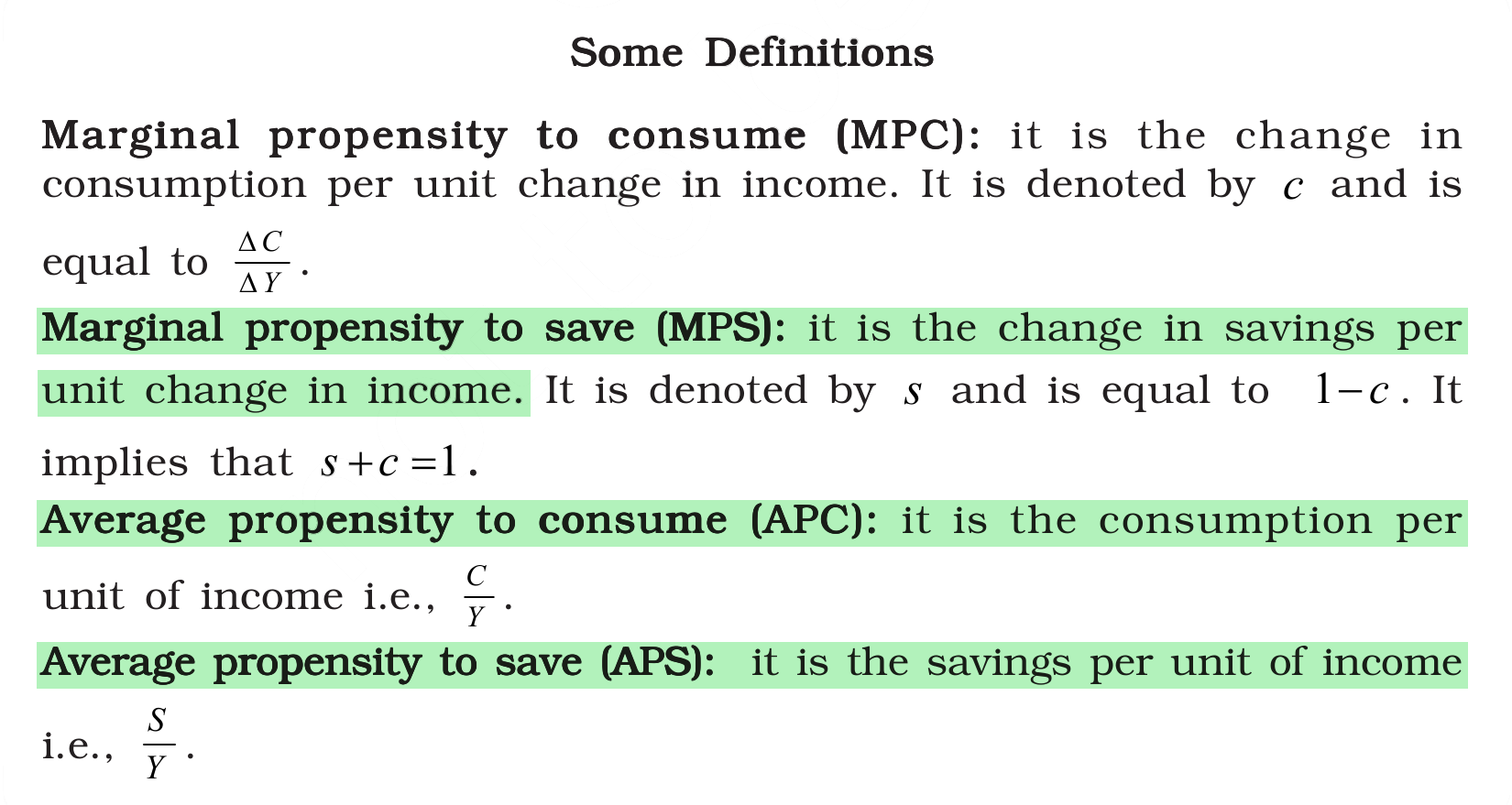
Average propensity to consume (APC) = C ÷ Y, consumption per unit of income, and average propensity to save (APS) = S ÷ Y, saving per unit of income; together APC + APS = 1.
Marginal propensity to consume (MPC) = ΔC ÷ ΔY, the share of extra income spent, which is the slope of the consumption curve; marginal propensity to save (MPS) = ΔS ÷ ΔY = 1 − MPC, the share saved, which is the slope of the saving curve.
At low incomes people consume more than they earn; the income at which consumption just equals income, C = Y, is the break-even point, where saving is zero. Since saving is income not consumed, S = Y − C, the consumption function gives
S = −C̅ + (1 − c)Y
The saving curve rises by (1 − c) for each unit of income, so its slope is the MPS, not the MPC; Option (4) wrongly gives it the slope of the consumption curve.
The other options are correct statements
Option (1) APC = 1, at break even point — Correct statement (not the answer). At the break-even point the whole income is consumed, C = Y, so APC = C ÷ Y = 1.
Option (2) APS = 0, at break even level of income — Correct statement (not the answer). At the same level of income saving is zero, since nothing is left after consumption, so APS = S ÷ Y = 0, and APC + APS = 1 + 0 = 1.
Option (3) MPC is the slope of Aggregate Demand — Correct statement (not the answer). Aggregate demand is C̅ + I̅ + cY. Only consumption changes with income, so the slope of the aggregate demand line is c, the same as that of the consumption function, and the two lines are parallel.
NCERT: Introductory Macroeconomics — Chapter 4: Determination of Income and Employment (2025-26)
|