What is "demographic dividend"?
Answer & explanation
Correct answer: option 4
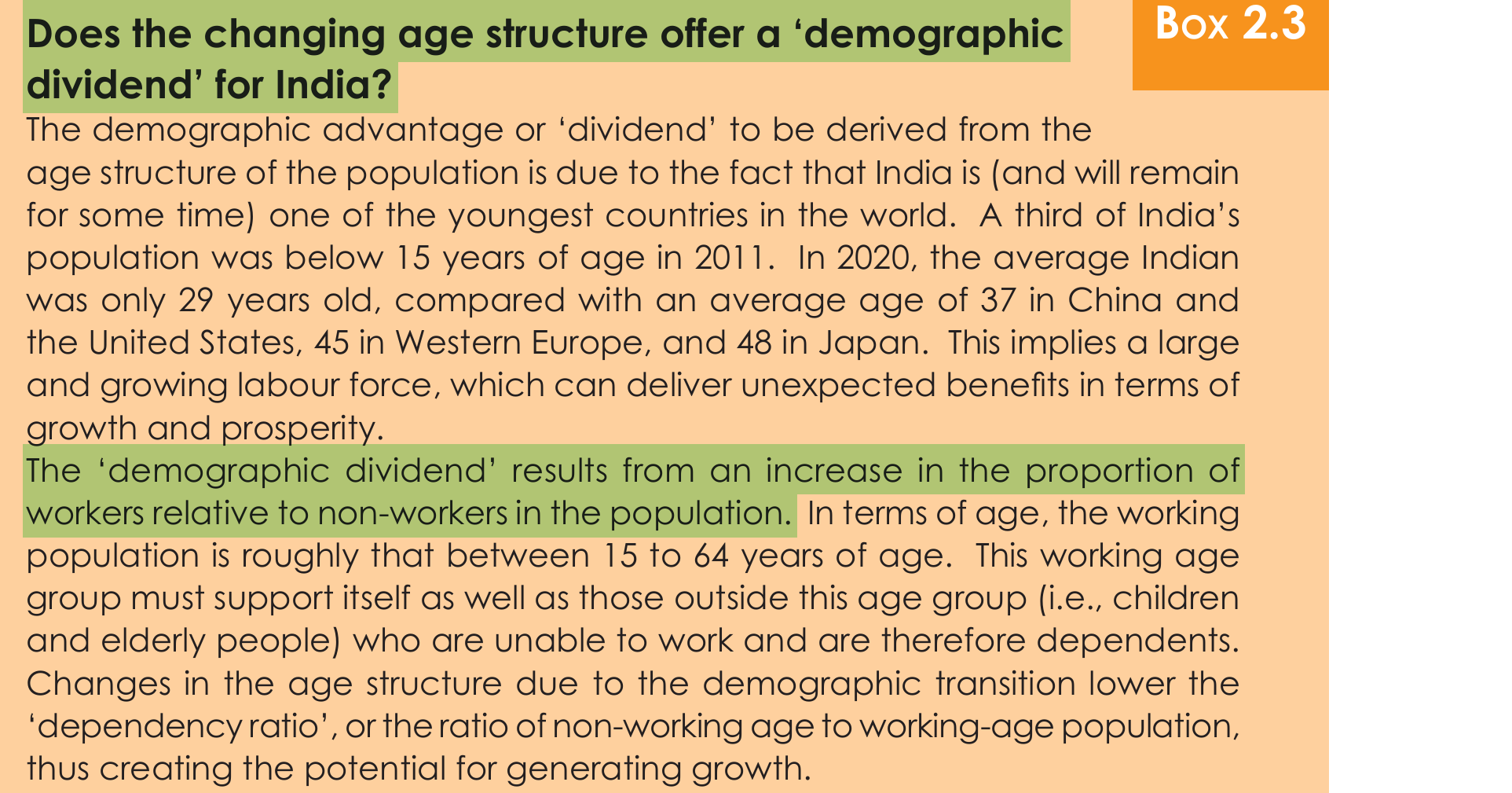
The correct answer is Option (4) → It happens with an increase in the proportion of workers relative to non-workers in the population.
Option (1) It happens when both the birth rate and the death rate are low in the population. — Incorrect. Low birth and death rates mark the last stage of the demographic transition, a developed society with low growth. That describes the rates of population change; the dividend is about the share of working people in the population.
Option (2) It happens when there is high migration of the population from rural to urban areas. — Incorrect. Migration moves people from villages to towns but does not change the balance of workers and dependants in the whole population, which is what the dividend rests on.
Option (3) It happens when the birth rate is high but the death rate is low in the population. — Incorrect. This is the transitional stage of ‘population explosion’. A high birth rate adds children, who are dependants, so it raises the burden on workers instead of giving a dividend.
Option (4) It happens with an increase in the proportion of workers relative to non-workers in the population. — Correct. The ‘demographic dividend’ results from an increase in the proportion of workers relative to non-workers in the population. The working population, roughly those aged 15 to 64, supports the young and the old; when its share rises, the dependency ratio falls, and the country can grow faster, provided the new workers are educated and find employment.
NCERT: Indian Society — Chapter 2: The Demographic Structure of the Indian Society (2025-26)
|