
In the given gates the output, \( Y_1 \) for input A = 0, B = 1 and \( Y_2 \) for input A = 1, B = 1 are respectively:
Answer & explanation
Correct answer: option 1
The correct answer is Option (1) → \( Y_1 = 0,\ Y_2 = 0 \)
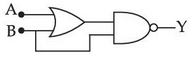
In the figure, A and B feed an OR gate, whose output is \( A + B \). This output and the input B are the two inputs of a NAND gate, which gives 0 only when both its inputs are 1.
\( \displaystyle Y = \overline{(A + B)\cdot B} \)
\( Y_1 \) and \( Y_2 \) are the output Y for the two given sets of inputs.
\( A = 0,\ B = 1:\ A + B = 1,\ (A + B)\cdot B = 1\cdot 1 = 1,\ Y_1 = \overline{1} = 0 \)
\( A = 1,\ B = 1:\ A + B = 1,\ (A + B)\cdot B = 1\cdot 1 = 1,\ Y_2 = \overline{1} = 0 \)
So \( Y_1 = 0 \) and \( Y_2 = 0 \).
Shortcut: By the absorption rule \( (A + B)\cdot B = B \), so \( Y = \overline{B} \). B = 1 in both cases, so both outputs are 0.