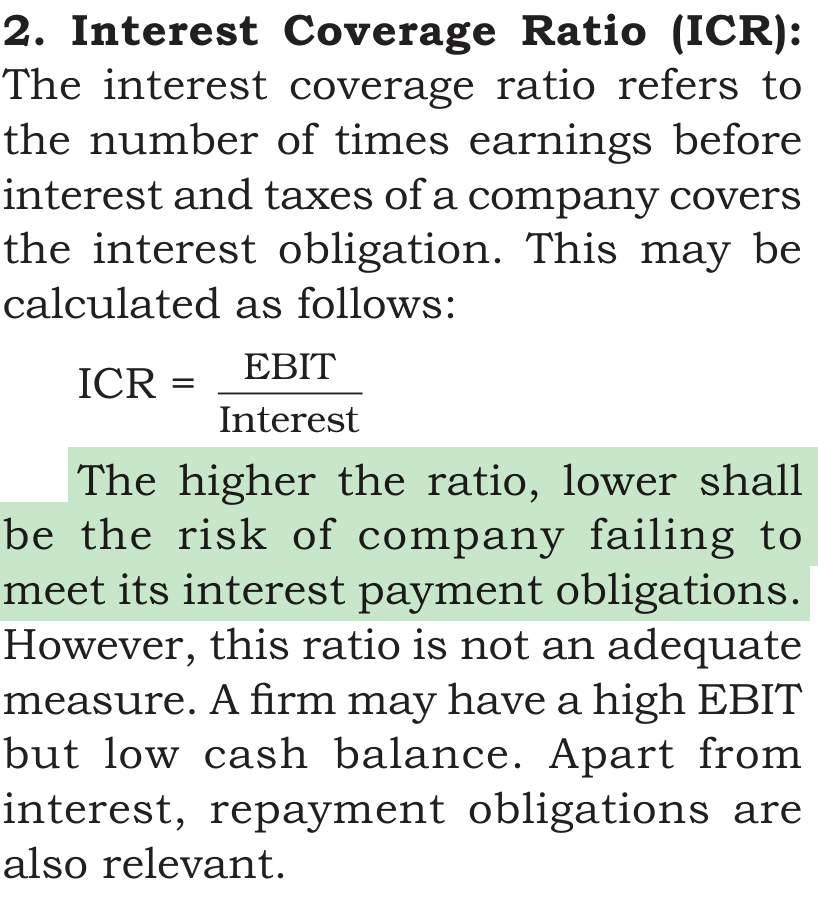
The following information is given for two firms:
| Firm A | Firm B | |
|---|---|---|
| EBIT | Rs. 20 lakh | Rs. 30 lakh |
| Interest | Rs. 4 lakh | Rs. 10 lakh |
Which firm has the lower risk of failing to meet its interest payment obligations, and why?
Answer & explanation
Correct answer: option 1
The correct answer is Option (1) → Firm A, because its interest coverage ratio is 5 times against 3 times for Firm B.
Given:
Firm A: EBIT = Rs. 20 lakh; Interest = Rs. 4 lakh
Firm B: EBIT = Rs. 30 lakh; Interest = Rs. 10 lakh
Interest coverage ratio (ICR) = EBIT ÷ Interest
Firm A: ICR = 20 ÷ 4 = 5 times
Firm B: ICR = 30 ÷ 10 = 3 times
The higher the ratio, the lower the risk of failing to pay interest, so Firm A carries the lower risk.
Option (2) Firm B, because its EBIT of Rs. 30 lakh is higher than that of Firm A. — Incorrect. Risk depends on how many times EBIT covers the interest, not on EBIT alone.
Option (3) Firm B, because its interest coverage ratio is 3 times against 5 times for Firm A. — Incorrect. The rule is read the wrong way: a lower ICR means a higher risk.
Option (4) Both firms carry the same risk, as each earns more than its interest. — Incorrect. The ratios differ, 5 times against 3 times, so the risks differ too.
NCERT (2026-27 Edition):
|