
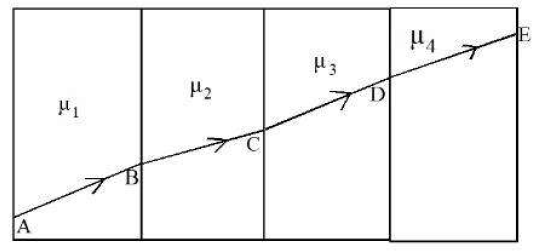
A ray of light passes through four transparent media with refractive index \( \mu_1, \mu_2, \mu_3 \) and \( \mu_4 \) shown in figure. The surfaces of all media are parallel. If BC and DE are parallel, we must have
Answer & explanation
Correct answer: option 3
The correct answer is Option (3) → \( \mu_2 = \mu_4 \)
At every surface Snell's law holds, and since all the surfaces are parallel the normal has the same direction everywhere. So the product \( \mu\sin\theta \) is the same in every medium.
\( \mu_1\sin\theta_1 = \mu_2\sin\theta_2 = \mu_3\sin\theta_3 = \mu_4\sin\theta_4 \)
In the figure, the segment BC lies in the medium \( \mu_2 \) and the segment DE in the medium \( \mu_4 \). If BC and DE are parallel, they make the same angle with the normal, so \( \theta_2 = \theta_4 \).
\( \mu_2\sin\theta_2 = \mu_4\sin\theta_4 \;\text{ with }\; \theta_2 = \theta_4 \;\Rightarrow\; \mu_2 = \mu_4 \)