CUETMOCK
  • Pricing
  • Mentors
Log inStart freeStart free mocks→

First test, then trust

Try a free CUET mock test.

Join 5,00,000+ students who rehearsed exam day on the exact NTA screen before sitting CUET. On the web and on Android.

Start free mocks →Get the Android app
CUETMOCK

India's #1 CUET Mock Test Platform. Original NCERT-based questions on the exact NTA exam screen — trusted by 5,00,000+ students since CUET 2022.

Get it onGoogle PlayScan to download the CUETMOCK app

Mock tests

  • CUET mock test series
  • Browse all papers
  • Commerce mocks
  • Humanities (Arts) mocks
  • Science mocks
  • Languages & GAT mocks
  • Free practice questions
  • Pricing

Resources

  • CUET exam guide
  • CUET syllabus
  • Universities accepting CUET
  • Expert blogs
  • News & notifications
  • Webinars & counselling
  • CUET score calculator
  • How we estimate your rank
  • FAQs

Company

  • About us
  • Our leadership & team
  • Our toppers
  • Mentors
  • For schools
  • Contact us
  • Terms
  • Privacy
  • Refund policy

Talk to us

+91 7696 6630 56info@cuetmock.comWhatsApp us

Our other platforms

  • JEE Mock — For IIT-JEE aspirants
  • NEET Mock — For NEET aspirants

Newsletter

Exam updates, study material and offers — no spam.

© 2026 NYC Ventures Pvt. Ltd.

701-702, Royal Business Park, Zirakpur, Punjab - 140603

  • Terms of use
  • Privacy policy
  • Refund policy
  • Contact us

iCUETMOCK is an independent preparation platform, not affiliated with the National Testing Agency (NTA). Always check exam details on the official NTA website.

  • Home
  • Mock tests
  • CUET guide
  • Pricing
  • Log in
Home/Practice questions/History
HistoryModern India: Colonialism and the Countryside

When was the 'Regulating Act' passed by the British Parliament to reg…

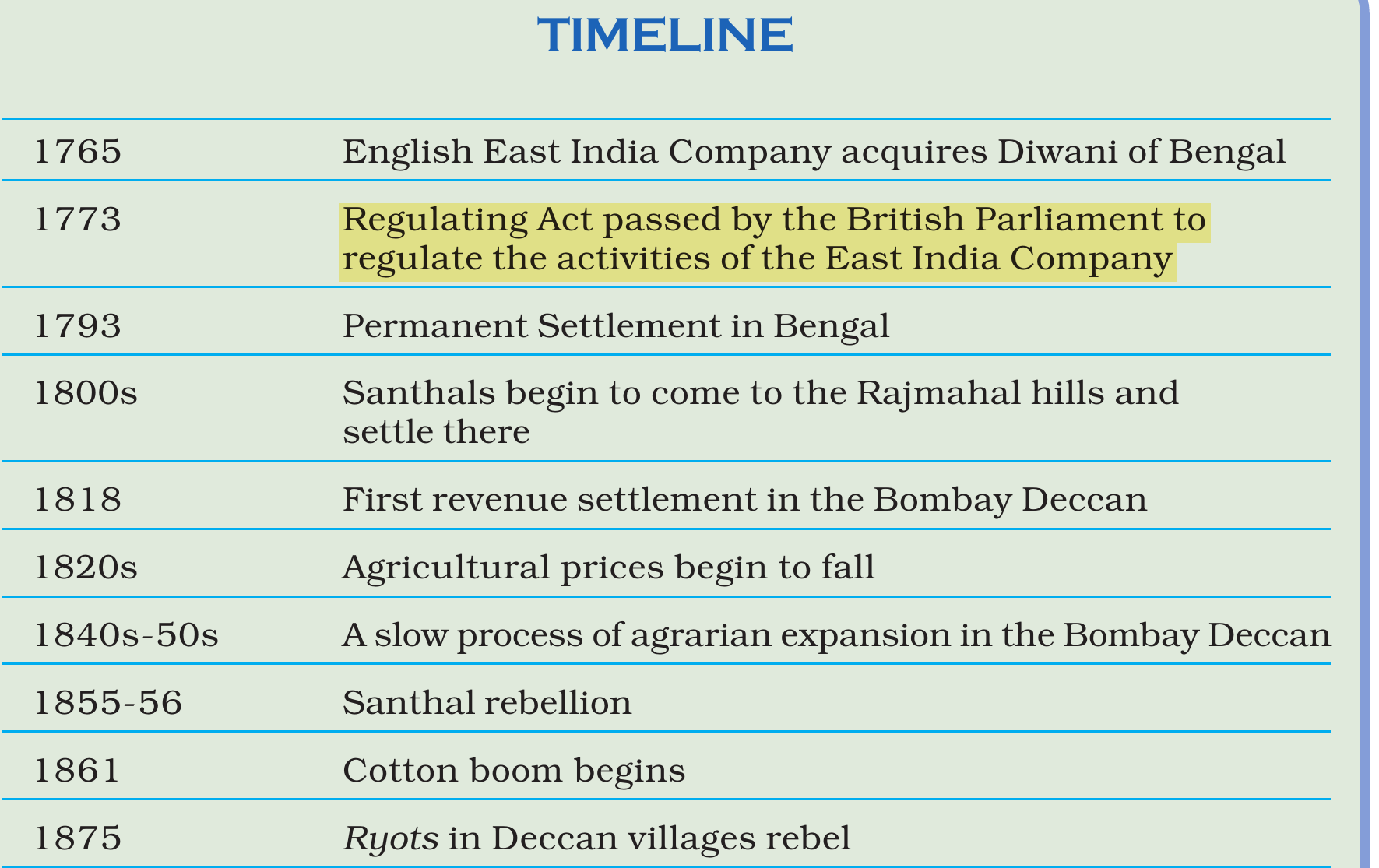
When was the 'Regulating Act' passed by the British Parliament to regulate the activities of the East India Company?

Answer & explanation+

Correct answer: option 1

The correct answer is Option (1) → 1773

The Regulating Act was passed by the British Parliament in 1773 to regulate the activities of the East India Company.


NCERT: Themes in Indian History Part III — Chapter 9: Colonialism and the Countryside (2026-27)

NCERT extract

Advertisement

Practise more on Modern India: Colonialism and the Countryside

Chapter-wise mocks on the real NTA exam screen, with solutions and your rank. Your first mocks are free.

Start free mocks →

Advertisement

Next questions

  1. If, for a non-zero x, 5x^2+7x+5= 0, then the value of x^3 +1/(x^3) is:General Aptitude Test · Quantitative Reasoning
  2. The number of integral roots of the equation x^4+√(x^4+20)=22, is _____.Maths. Section B1 · Relations and Functions
  3. The maxim actus non facit reum nisi mens sit rea was developed by which of the following?Legal Studies · Topics of Law
  4. Who were considered as 'theravadins'?History · Ancient India: Thinkers, Beliefs and Buildings
  5. In an alloy, there is 20% of copper. To get 69 Kg of copper, how much alloy is required?General Aptitude Test · Numerical Ability
  6. During 1991 crisis, India approached I.B.R.D. when it had no other option left, what is the full form of I.B.R.D.?Economics · Indian Economic Development: Liberalisation, Privatisation and Globalisation - An Appraisal
  7. What is the least number that should be added to 478 so that the number obtained is exactly divisible by 5, 6 and 12?General Aptitude Test · Numerical Ability
  8. Rearrange the following jumbled words to form a meaningful sentence : (A) are pollution(B) herbs and shrubs(C) the important(D) and loss of…English · Arrange in Meaningful Sequence
  9. Harappan seals, beads, weights, stone blades, baked bricks are some of the important items reported from _________. A. AfghanistanB. Pakist…History · Ancient India: Bricks, Beads and Bones
  10. From the following, choose the word that does NOT belong to the group.English · Odd One Out