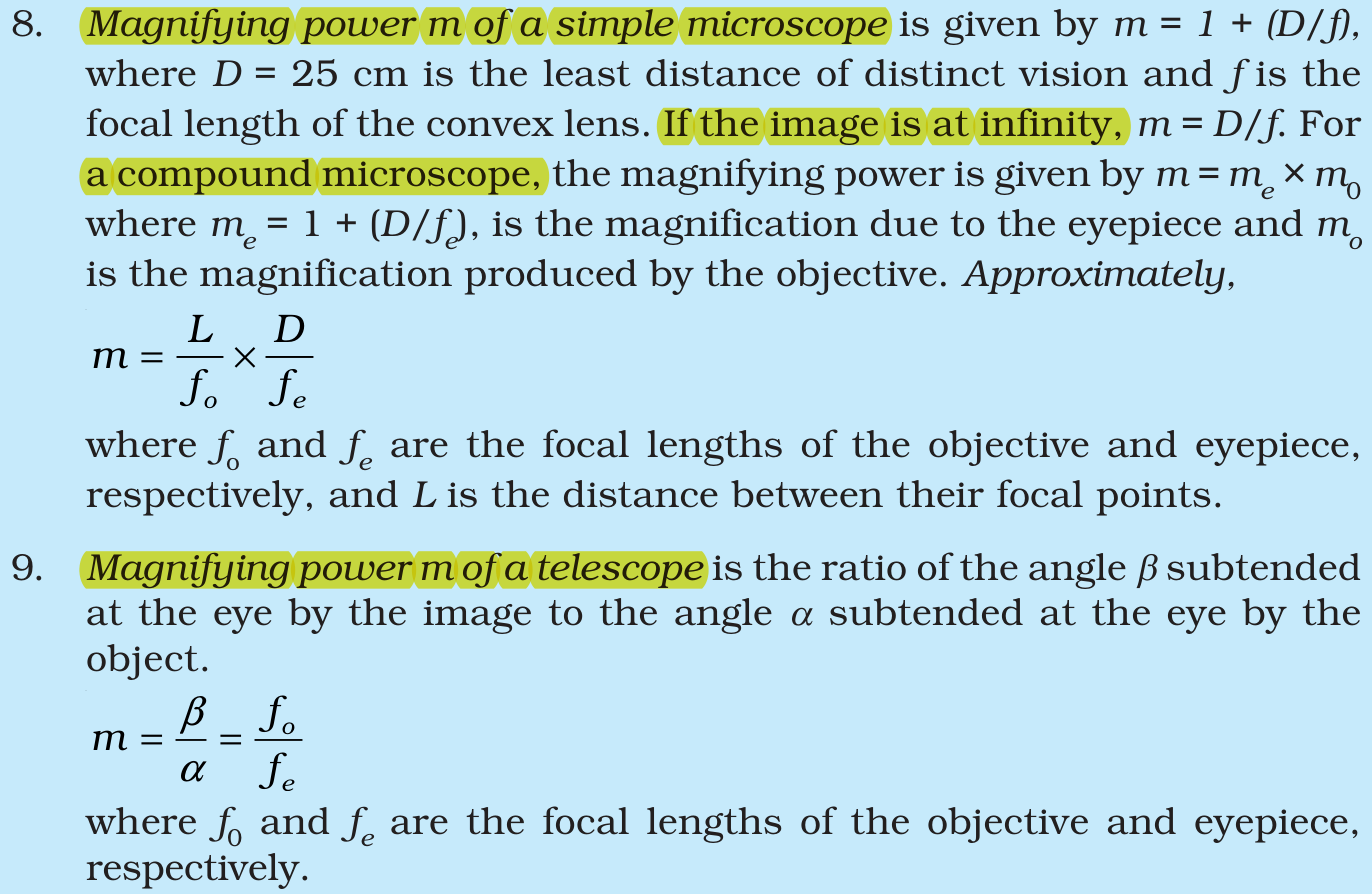
Match List-I with List-II
| List-I | List-II |
| Optical Instrument | Magnifying power |
| (A) Magnifying power m of a simple microscope | (I) \( m = 1 + (D/f) \) |
| (B) Magnifying power m of a simple microscope if the image is at infinity | (II) \( m = (L/f_0)\times(D/f_e) \) |
| (C) Magnifying power of a compound microscope | (III) \( m = f_0/f_e \) |
| (D) Magnifying power of a telescope | (IV) \( m = D/f \) |
Choose the correct answer from the options given below:
Answer & explanation
Correct answer: option 1
The correct answer is Option (1) → (A) - (I), (B) - (IV), (C) - (II), (D) - (III)
Each optical instrument has its own magnifying power expression, and the simple microscope has two: one for the image at the near point and one for the image at infinity.
(A) Magnifying power m of a simple microscope — this matches (I) \( m = 1 + (D/f) \). The usual case is the final image at the least distance of distinct vision \( D \).
(B) Magnifying power m of a simple microscope if the image is at infinity — this matches (IV) \( m = D/f \). The object is at the focus and the image forms at infinity, so the term 1 is not added.
(C) Magnifying power of a compound microscope — this matches (II) \( m = (L/f_0)\times(D/f_e) \). It is the product of the objective's magnification \( L/f_0 \) and the eyepiece's \( D/f_e \), with \( L \) the tube length.
(D) Magnifying power of a telescope — this matches (III) \( m = f_0/f_e \). It is the ratio of the focal length of the objective to that of the eyepiece, for the final image at infinity.
NCERT (2026-27):
Summary – …