
If $A=\left\{(x, y): y=\frac{1}{x}, 0 \neq x \in R\right\}$ and $B=\{(x, y): y=-x, x \in R\}$, then
Answer & explanation
Correct answer: option 3
Y = 1/X or XY = 1.
So A is the set of all points on the rectangular hyperbola xy = 1 with branches in I and III quadrants. y = –x represents a line with slope –1 and c is equal to 0.
Therefore B is the set of all points on this line. Since the graphs of xy = 1 and y = –x are non intersecting, we have A ∩ B = φ
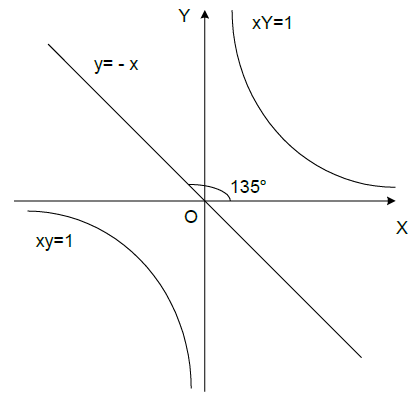
Hence (3) is the correct answer.