
In the figure, P is a small magnetised needle at the point O. The arrow on P shows the direction of its magnetic moment. Q is another needle, identical to P. The arrows Q1 to Q6 show different positions and directions of Q.
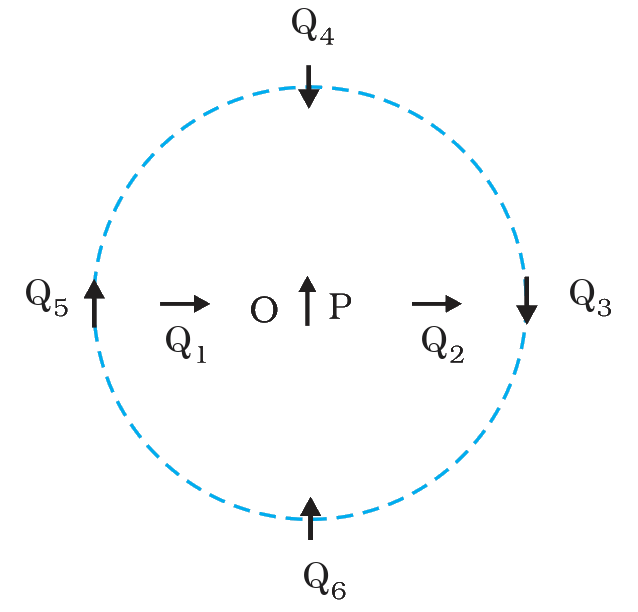
For which arrangement is the potential energy of the system the highest?
Answer & explanation
Correct answer: option 4
The correct answer is Option (4) → PQ4
The potential energy of the pair is the energy of Q in the field of P, \( U=-\mathbf{m}_Q\cdot\mathbf{B}_P \). It is highest when \( \mathbf{m}_Q \) points against \( \mathbf{B}_P \) and the field is strongest. At the same distance, the field of P on its axis is twice the field on its normal bisector. P points upwards, so Q4 and Q6 lie on its axis. Q3 and Q5 lie on its normal bisector.
Option (1) PQ2 — Incorrect. Q2 is on the normal bisector, where the field of P points downwards. Q2 points sideways, at \( 90^\circ \) to this field. So \( U=0 \), even though Q2 is closer to P.
Option (2) PQ5 — Incorrect. On the normal bisector the field points downwards, and Q5 points up. So \( U \) is positive here. But this field is only half the axial field, so \( U \) is half the value for PQ4.
Option (3) PQ6 — Incorrect. Below P on the axis, the field points upwards, and Q6 also points up. Q6 is parallel to the field, so \( U \) is negative. This arrangement has the lowest energy.
Option (4) PQ4 — Correct. Above P on the axis, the field points upwards, but Q4 points down. It is anti-parallel to the stronger axial field, so \( U=+\frac{\mu_0}{4\pi}\frac{2m^{2}}{r^{3}} \), the highest value.
NCERT (2026-27):
Example 5.2 – “Potential energy of the configuration arises due to the potential energy of one dipole (say, Q) in the magnetic field due to other (P). Use the result that the field due to P is given by the expression …:”
\( \displaystyle \mathbf{B}_P=-\frac{\mu_0}{4\pi}\frac{\mathbf{m}_P}{r^{3}} \quad \text{(on the normal bisector)} \)
\( \displaystyle \mathbf{B}_P=\frac{\mu_0}{4\pi}\frac{2\mathbf{m}_P}{r^{3}} \quad \text{(on the axis)} \)
“where mP is the magnetic moment of the dipole P. Equilibrium is stable when mQ is parallel to BP, and unstable when it is anti-parallel to BP.”
FIGURE 5.4