CUETMOCK
  • Pricing
  • Mentors
Log inStart freeStart free mocks→

First test, then trust

Try a free CUET mock test.

Join 5,00,000+ students who rehearsed exam day on the exact NTA screen before sitting CUET. On the web and on Android.

Start free mocks →Get the Android app
CUETMOCK

India's #1 CUET Mock Test Platform. Original NCERT-based questions on the exact NTA exam screen — trusted by 5,00,000+ students since CUET 2022.

Get it onGoogle PlayScan to download the CUETMOCK app

Mock tests

  • CUET mock test series
  • Browse all papers
  • Commerce mocks
  • Humanities (Arts) mocks
  • Science mocks
  • Languages & GAT mocks
  • Free practice questions
  • Pricing

Resources

  • CUET exam guide
  • CUET syllabus
  • Universities accepting CUET
  • Expert blogs
  • News & notifications
  • Webinars & counselling
  • CUET score calculator
  • How we estimate your rank
  • FAQs

Company

  • About us
  • Our leadership & team
  • Our toppers
  • Mentors
  • For schools
  • Contact us
  • Terms
  • Privacy
  • Refund policy

Talk to us

+91 7696 6630 56info@cuetmock.comWhatsApp us

Our other platforms

  • JEE Mock — For IIT-JEE aspirants
  • NEET Mock — For NEET aspirants

Newsletter

Exam updates, study material and offers — no spam.

© 2026 NYC Ventures Pvt. Ltd.

701-702, Royal Business Park, Zirakpur, Punjab - 140603

  • Terms of use
  • Privacy policy
  • Refund policy
  • Contact us

iCUETMOCK is an independent preparation platform, not affiliated with the National Testing Agency (NTA). Always check exam details on the official NTA website.

  • Home
  • Mock tests
  • CUET guide
  • Pricing
  • Log in
Home/Practice questions/Economics
EconomicsMicro Economics: Production and Costs

Choose the incorrect statement from the following with reference to t…

Choose the incorrect statement from the following with reference to the cost curve.

Answer & explanation+

Correct answer: option 4

The correct answer is Option (4) → TC and TVC are always parallel and the reason of gap is AFC

In the short run a firm has two kinds of cost. Some, such as the rent of the factory, must be paid whatever it produces, even at zero output; together they make the total fixed cost (TFC). Others, such as the wages of extra workers and raw materials, rise with output; they make the total variable cost (TVC). Adding the two gives the total cost: TC = TVC + TFC.

On a graph this gives three curves:

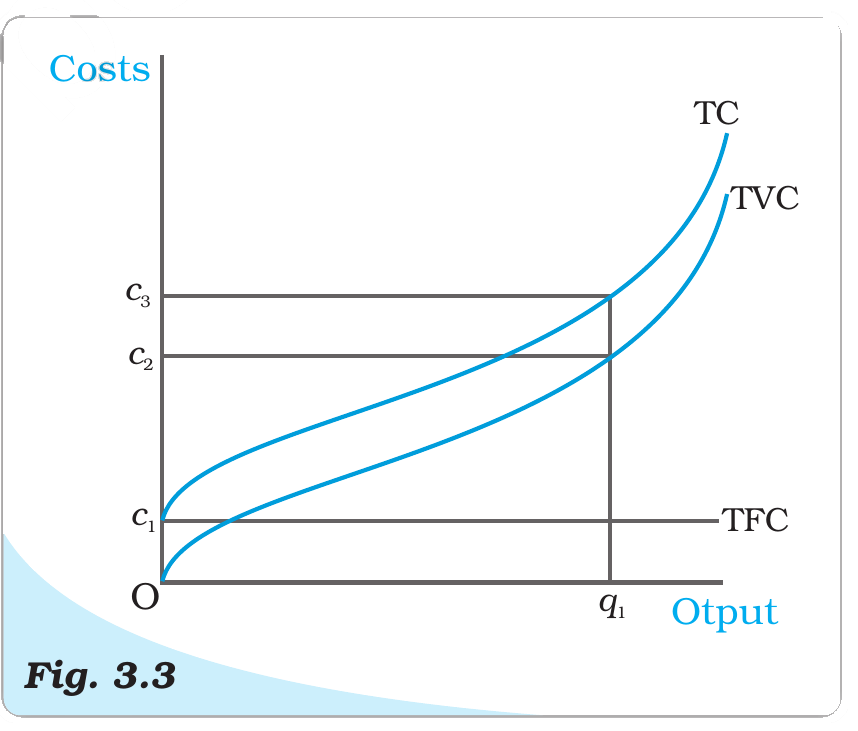
  • TFC does not change with output, so it is a horizontal line.

  • TVC is zero at zero output and rises as output rises.

  • TC is the TVC curve lifted up by the same amount, TFC, at every level of output, so the gap between TC and TVC is always TFC.

Average fixed cost (AFC) is a different thing: it is TFC divided by output, so it keeps falling as output rises.

Option (1) TFC curve is independent of level of output — Correct statement. Fixed cost is the same at every level of output, which is why the TFC curve is a horizontal straight line.

Option (2) TC and TVC are always parallel and the reason of gap is TFC — Correct statement. The vertical distance between TC and TVC is TFC, which is constant, so the two curves run parallel to each other.

Option (3) TVC curve starts from origin and it shows increasing, constant and decreasing return — Correct statement. At zero output there is no variable cost, so TVC starts from the origin. Its shape follows the returns to the variable factor: it rises at a falling rate while returns are increasing and at a rising rate once returns diminish.

Option (4) TC and TVC are always parallel and the reason of gap is AFC — Incorrect statement. The gap between TC and TVC is TFC, not AFC. Since AFC keeps falling as output rises, a gap equal to AFC would narrow, and the two curves could not stay parallel.


NCERT (2025-26): “Shapes of the Short Run Cost Curves …Previously, we have discussed that in order to increase the production of output the firm needs to employ more of the variable inputs. This results in an increase in total variable cost, and hence, an increase in total cost. Therefore, as output increases, total variable cost and total cost increase. Total fixed cost, however, is independent of the amount of output produced and remains constant for all levels of production.

Figure 3.3 illustrates the shapes of total fixed cost, total variable cost and total cost curves for a typical firm. We place output on the x-axis and costs on the y-axis. TFC is a constant which takes the value c1 and does not change with the change in output. It is, therefore, a horizontal straight line cutting the cost axis at the point c1. At q1, TVC is c2 and TC is c3.…

Fig. 3.3: …Total cost is the vertical sum of total fixed cost and total variable cost.”

NCERT extract

Advertisement

Practise more on Micro Economics: Production and Costs

Chapter-wise mocks on the real NTA exam screen, with solutions and your rank. Your first mocks are free.

Start free mocks →

Advertisement

Next questions

  1. Identify the kings/rulers, whose coins contain the names of kings written in Greek and Kharosthi scripts?History · Ancient India: Kings, Farmers and Towns
  2. Select the correct figure of speech used in the following sentence:The more haste, the less speed.English · Figure of Speech
  3. In which year was ‘Sanchi’ declared a World Heritage Site?History · Ancient India: Thinkers, Beliefs and Buildings
  4. The perimeter of a rhombus is 148 cm, and one of its diagonals is 24 cm. The area (in cm2 ) of the rhombus is:General Aptitude Test · Quantitative Reasoning
  5. Which one is Brand name of Cosmetics?Entrepreneurship · Entrepreneurial Opportunity
  6. Mr. X invested Rs. 2000 in a mutual fund in the year 2015. The value of the fund increased to Rs. 3200 in the year 2020. The compound annua…Applied Maths. Section B2 · Financial Mathematics
  7. Let f(x)=≤ft […] . then the points where f (x) is not differentiable areMaths. Section B1 · Continuity and Differentiability
  8. Choose the correct meaning of the underlined idiom. After two years of losses, the company cut its extra costs and staff to become lean and…English · Grammar: Idioms
  9. ‘Repetitive performance of a particular task allows a worker to gain experience in that area.’ Which importance of organising is highlighte…Business Studies · Organising
  10. At what time between 9 and 10 o’clock will the hands of a clock be in the same straight line but not together?General Aptitude Test · Verbal Reasoning