CUETMOCK
  • Pricing
  • Mentors
Log inStart freeStart free mocks→

First test, then trust

Try a free CUET mock test.

Join 5,00,000+ students who rehearsed exam day on the exact NTA screen before sitting CUET. On the web and on Android.

Start free mocks →Get the Android app
CUETMOCK

India's #1 CUET Mock Test Platform. Original NCERT-based questions on the exact NTA exam screen — trusted by 5,00,000+ students since CUET 2022.

Get it onGoogle PlayScan to download the CUETMOCK app

Mock tests

  • CUET mock test series
  • Browse all papers
  • Commerce mocks
  • Humanities (Arts) mocks
  • Science mocks
  • Languages & GAT mocks
  • Free practice questions
  • Pricing

Resources

  • CUET exam guide
  • CUET syllabus
  • Universities accepting CUET
  • Expert blogs
  • News & notifications
  • Webinars & counselling
  • CUET score calculator
  • How we estimate your rank
  • FAQs

Company

  • About us
  • Our leadership & team
  • Our toppers
  • Mentors
  • For schools
  • Contact us
  • Terms
  • Privacy
  • Refund policy

Talk to us

+91 7696 6630 56info@cuetmock.comWhatsApp us

Our other platforms

  • JEE Mock — For IIT-JEE aspirants
  • NEET Mock — For NEET aspirants

Newsletter

Exam updates, study material and offers — no spam.

© 2026 NYC Ventures Pvt. Ltd.

701-702, Royal Business Park, Zirakpur, Punjab - 140603

  • Terms of use
  • Privacy policy
  • Refund policy
  • Contact us

iCUETMOCK is an independent preparation platform, not affiliated with the National Testing Agency (NTA). Always check exam details on the official NTA website.

  • Home
  • Mock tests
  • CUET guide
  • Pricing
  • Log in
Home/Practice questions/History
HistoryAncient India: Thinkers, Beliefs and Buildings

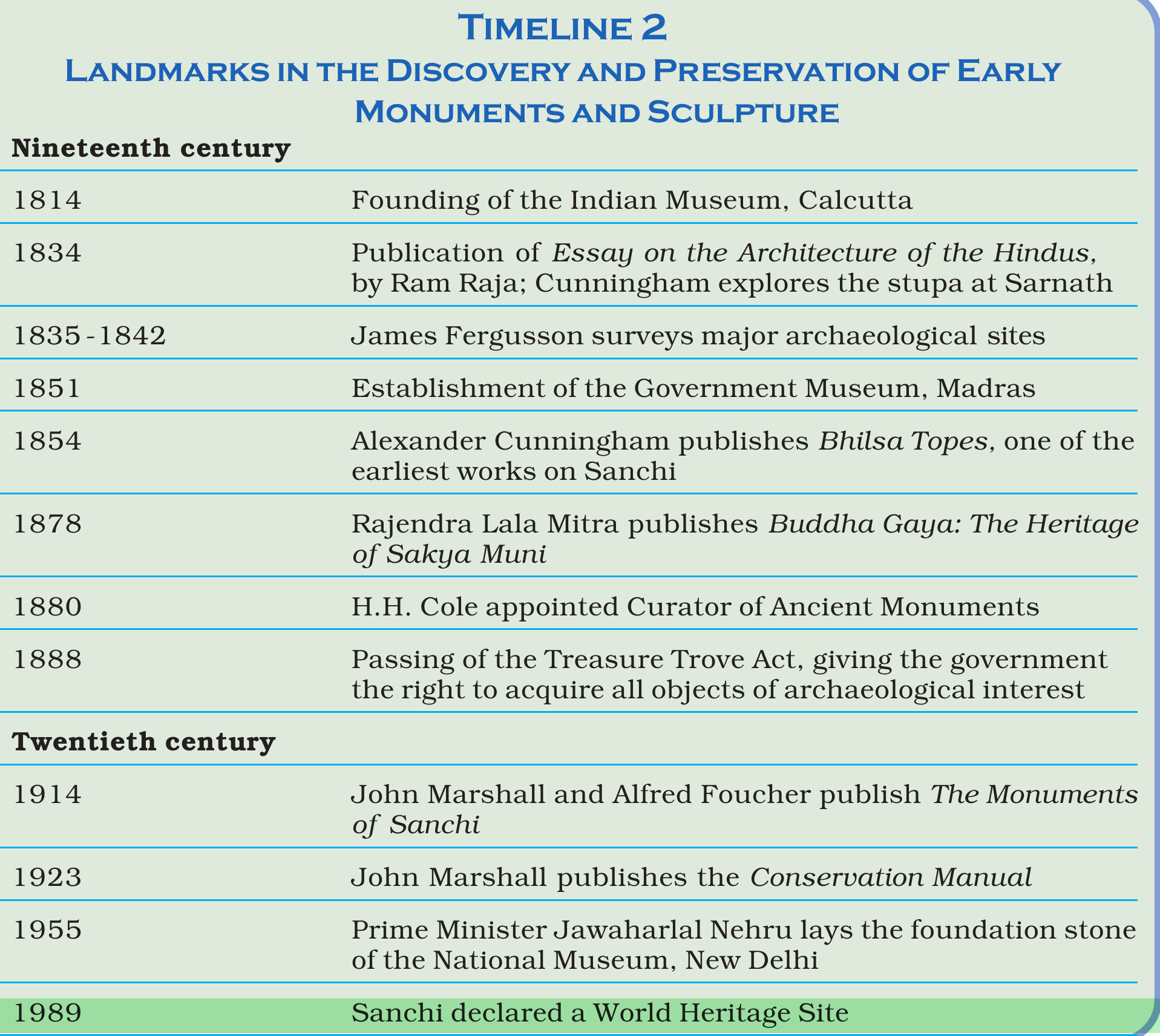
In which year was ‘Sanchi’ declared a World Heritage Site?

In which year was ‘Sanchi’ declared a World Heritage Site?

Answer & explanation+

Correct answer: option 1

The correct answer is Option (1) → 1989

The great stupa at Sanchi is one of the most famous Buddhist monuments of early India. After more than a century of exploration, publication and conservation, from Cunningham’s Bhilsa Topes (1854) to John Marshall’s work in the twentieth century, Sanchi was declared a World Heritage Site in 1989.

Note: A same/similar question was asked in CUET (UG) in the papers below.

20262025202420232022
21-05 S1––10-06 S3*
12-06 S2*
13-06 S2*
19-06 S2*
–

* A similar question.


NCERT: Themes in Indian History Part I — Chapter 4: Thinkers, Beliefs and Buildings (2025-26)

NCERT extract

Advertisement

Practise more on Ancient India: Thinkers, Beliefs and Buildings

Chapter-wise mocks on the real NTA exam screen, with solutions and your rank. Your first mocks are free.

Start free mocks →

Advertisement

Next questions

  1. The perimeter of a rhombus is 148 cm, and one of its diagonals is 24 cm. The area (in cm2 ) of the rhombus is:General Aptitude Test · Quantitative Reasoning
  2. Which one is Brand name of Cosmetics?Entrepreneurship · Entrepreneurial Opportunity
  3. Mr. X invested Rs. 2000 in a mutual fund in the year 2015. The value of the fund increased to Rs. 3200 in the year 2020. The compound annua…Applied Maths. Section B2 · Financial Mathematics
  4. Let f(x)=≤ft […] . then the points where f (x) is not differentiable areMaths. Section B1 · Continuity and Differentiability
  5. Choose the correct meaning of the underlined idiom. After two years of losses, the company cut its extra costs and staff to become lean and…English · Grammar: Idioms
  6. ‘Repetitive performance of a particular task allows a worker to gain experience in that area.’ Which importance of organising is highlighte…Business Studies · Organising
  7. At what time between 9 and 10 o’clock will the hands of a clock be in the same straight line but not together?General Aptitude Test · Verbal Reasoning
  8. Griffith Taylor was related to which school of thought?Geography · Fundamentals of Human Geography: Human Geography-Nature and Scope
  9. Hariprasad Chaurasia is associated with which of the following instruments?General Aptitude Test · General Knowledge
  10. Ramesh's view about the people of his own caste is best described as:Sociology · Indian Society: Patterns of Social Inequality and Exclusion