
CUETMOCK
  • Pricing
  • Mentors
Log inStart freeStart free mocks→

First test, then trust

Try a free CUET mock test.

Join 5,00,000+ students who rehearsed exam day on the exact NTA screen before sitting CUET. On the web and on Android.

Start free mocks →Get the Android app
CUETMOCK

India's #1 CUET Mock Test Platform. Original NCERT-based questions on the exact NTA exam screen — trusted by 5,00,000+ students since CUET 2022.

Get it onGoogle PlayScan to download the CUETMOCK app

Mock tests

  • CUET mock test series
  • Commerce mocks
  • Humanities (Arts) mocks
  • Science mocks
  • Languages & GAT mocks
  • Free practice questions
  • Pricing

Resources

  • CUET exam guide
  • CUET syllabus
  • Universities accepting CUET
  • Expert blogs
  • News & notifications
  • Webinars & counselling
  • CUET score calculator
  • How we estimate your rank
  • FAQs

Company

  • About us
  • Our leadership & team
  • Our toppers
  • Mentors
  • For schools
  • Contact us
  • Terms
  • Privacy
  • Refund policy

Talk to us

+91 7696 6630 56info@cuetmock.comWhatsApp us

Our other platforms

  • JEE Mock — For IIT-JEE aspirants
  • NEET Mock — For NEET aspirants

Newsletter

Exam updates, study material and offers — no spam.

© 2026 NYC Ventures Pvt. Ltd.

701-702, Royal Business Park, Zirakpur, Punjab - 140603

  • Terms of use
  • Privacy policy
  • Refund policy
  • Contact us

iCUETMOCK is an independent preparation platform, not affiliated with the National Testing Agency (NTA). Always check exam details on the official NTA website.

  • Home
  • Mock tests
  • CUET guide
  • Pricing
  • Log in
Home/Practice questions/Chemistry
ChemistryPhysical: Chemical Kinetics

The rate constants of a reaction at 700 K and 500 K are 0.07 s−1 and…

Rate of Chemical Reaction

Chemical reactions are the simplest way to convert one substance into the other substance. The feasibility of a chemical reaction is decided by the concepts of chemical thermodynamics under a defined set of conditions. The extent of a chemical reaction is determined by the principles of chemical equilibrium. But the information that remains undisclosed is the speed or rate of a chemical reaction, path or mechanism of a chemical reaction, time taken for a reaction to attain a state of equilibrium, factors controlling the rate of reaction etc. This information pertaining to the study of a chemical reaction is very pivotal, and it helps in understanding the nature (slow or fast nature) of a chemical reaction. The kinetics of a chemical reaction can be understood with the help of average rate of reaction or a differential rate law or an integrated rate law. There are various factors on which the rate of a chemical reaction depends viz. nature of reactants, temperature, catalyst, pressure and concentration of reactants and products (rate law expression).

The rate constants of a reaction at 700 K and 500 K are 0.07 s−1 and 0.02 s−1 respectively. What is the value of activation energy of the reaction?

(Given: log 7 = 0.8451, log 2 = 0.3010)

Answer & explanation+

Correct answer: option 3

The correct answer is Option (3) → 18.230 kJ mol−1

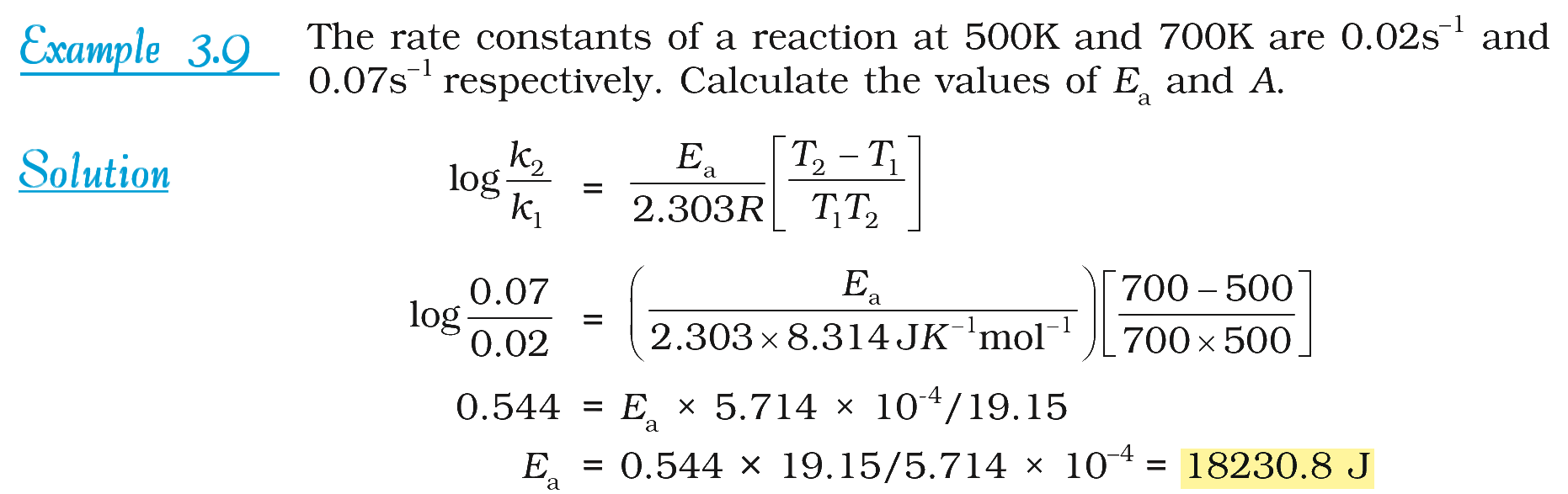
The Arrhenius equation relates the rate constant to temperature. Taking the rate constants at two temperatures gives:

    \( \displaystyle \log\frac{k_2}{k_1}=\frac{E_a}{2.303R}\left(\frac{T_2-T_1}{T_1T_2}\right) \)

Here \( k_1 = 0.02\ \mathrm{s^{-1}} \) at \( T_1 = 500\ \mathrm{K} \), \( k_2 = 0.07\ \mathrm{s^{-1}} \) at \( T_2 = 700\ \mathrm{K} \), and \( R = 8.314\ \mathrm{J\,K^{-1}\,mol^{-1}} \).

    \( \displaystyle \frac{k_2}{k_1}=\frac{0.07}{0.02}=\frac{7}{2} \)

    \( \displaystyle \log\frac{7}{2}=\log 7-\log 2=0.8451-0.3010=0.5441 \)

    \( \displaystyle \frac{T_2-T_1}{T_1T_2}=\frac{200}{500\times700}=\frac{1}{1750}\ \mathrm{K^{-1}} \)

    \( \displaystyle E_a=0.5441\times2.303\times8.314\times1750 \)

    \( \displaystyle E_a\approx18231\ \mathrm{J\,mol^{-1}} \)

So \( E_a \) = 18230.8 J mol−1 = 18.230 kJ mol−1.

Note 1: This question is from NCERT (2026-27). NTA sets numerical questions from NCERT too, so do not ignore NCERT while practising numericals.

NCERT (2026-27 edition):
Temperature Dependence of the Rate of a Reaction – …
Textbook extract

Note 2: The same/similar question has been asked in different years by NTA as per the details given below:

20262025202420232022
15-05 S1
11-05 S1
––––

Advertisement

Practise more on Physical: Chemical Kinetics

Chapter-wise mocks on the real NTA exam screen, with solutions and your rank. Your first mocks are free.

Start free mocks →

Advertisement

Next questions

  1. Identify the kings/rulers, whose coins contain the names of kings written in Greek and Kharosthi scripts?History · Ancient India: Kings, Farmers and Towns
  2. Select the correct figure of speech used in the following sentence:The more haste, the less speed.English · Figure of Speech
  3. In which year was ‘Sanchi’ declared a World Heritage Site?History · Ancient India: Thinkers, Beliefs and Buildings
  4. The perimeter of a rhombus is 148 cm, and one of its diagonals is 24 cm. The area (in cm2 ) of the rhombus is:General Aptitude Test · Quantitative Reasoning
  5. Which one is Brand name of Cosmetics?Entrepreneurship · Entrepreneurial Opportunity
  6. Mr. X invested Rs. 2000 in a mutual fund in the year 2015. The value of the fund increased to Rs. 3200 in the year 2020. The compound annua…Applied Maths. Section B2 · Financial Mathematics
  7. Let f(x)=≤ft […] . then the points where f (x) is not differentiable areMaths. Section B1 · Continuity and Differentiability
  8. Choose the correct meaning of the underlined idiom. After two years of losses, the company cut its extra costs and staff to become lean and…English · Grammar: Idioms
  9. ‘Repetitive performance of a particular task allows a worker to gain experience in that area.’ Which importance of organising is highlighte…Business Studies · Organising
  10. At what time between 9 and 10 o’clock will the hands of a clock be in the same straight line but not together?General Aptitude Test · Verbal Reasoning