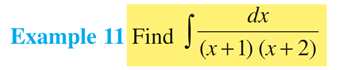
\(\displaystyle\int\frac{1}{(x + 1)(x+2)}dx\) is equal to
Answer & explanation
Correct answer: option 2
The correct answer is Option (2) → \(\log_e\left|\displaystyle\frac{x+1}{x+2}\right|+C\): where \(C\) is an arbitrary constant
Using partial fractions, let
\( \displaystyle \frac{1}{(x+1)(x+2)} = \frac{A}{x+1} + \frac{B}{x+2} \)
\(1 = A(x+2) + B(x+1)\)
Putting x = −1 and then x = −2:
\(A = 1,\quad B = -1\)
So
\( \displaystyle \int\frac{dx}{(x+1)(x+2)} = \int\frac{dx}{x+1} - \int\frac{dx}{x+2} \)
\(= \log_e|x+1| - \log_e|x+2| + C\)
\( \displaystyle = \log_e\left|\frac{x+1}{x+2}\right| + C \)
Why the other options are incorrect
Option (1) \(\log_e\left|\displaystyle\frac{x+2}{x+1}\right|+C\): where \(C\) is an arbitrary constant — Incorrect. This is \(\log_e|x+2| - \log_e|x+1|\), the negative of the answer: the signs of the two logs are reversed.
Option (3) \(\log_e|(x+1)(x+2)| + C\): where \(C\) is an arbitrary constant — Incorrect. This is \(\log_e|x+1| + \log_e|x+2|\); its derivative is \(\frac{2x+3}{(x+1)(x+2)}\), not \(\frac{1}{(x+1)(x+2)}\).
Option (4) \(\log_e|2x + 3| + C\): where \(C\) is an arbitrary constant — Incorrect. Its derivative is \(\frac{2}{2x+3}\), not \(\frac{1}{(x+1)(x+2)}\).
NCERT (2026-27 edition):
Integration by Partial Fractions