
How does the molar conductivity of a weak electrolyte such as acetic acid change as its concentration decreases?
Answer & explanation
Correct answer: option 1
The correct answer is Option (1) → It increases, very steeply in very dilute solutions
Molar conductivity, Λm, is the conductance of the volume of solution that contains 1 mol of the electrolyte. Acetic acid is only partly dissociated; on dilution its degree of dissociation increases, so the same 1 mol gives more ions and Λm rises, very steeply at low concentrations.
Why the other options are incorrect
Option (2) It decreases steadily — Incorrect. It is the conductivity (κ) that decreases on dilution, because there are fewer ions per unit volume; molar conductivity increases.
Option (3) It remains constant — Incorrect. The number of ions from 1 mol of a weak electrolyte changes with dilution, so Λm cannot stay constant.
Option (4) It first increases and then decreases — Incorrect. Λm keeps rising as the concentration falls and reaches its limiting value Λ°m at infinite dilution, where dissociation is complete; it does not fall.
NCERT (2026-27 edition):
Weak Electrolytes – “Weak electrolytes like acetic acid have lower degree of dissociation at higher concentrations and hence for such electrolytes, the change in Λm with dilution is due to increase in the degree of dissociation and consequently the number of ions in total volume of solution that contains 1 mol of electrolyte. In such cases Λm increases steeply (Fig. 2.6) on dilution, especially near lower concentrations.”
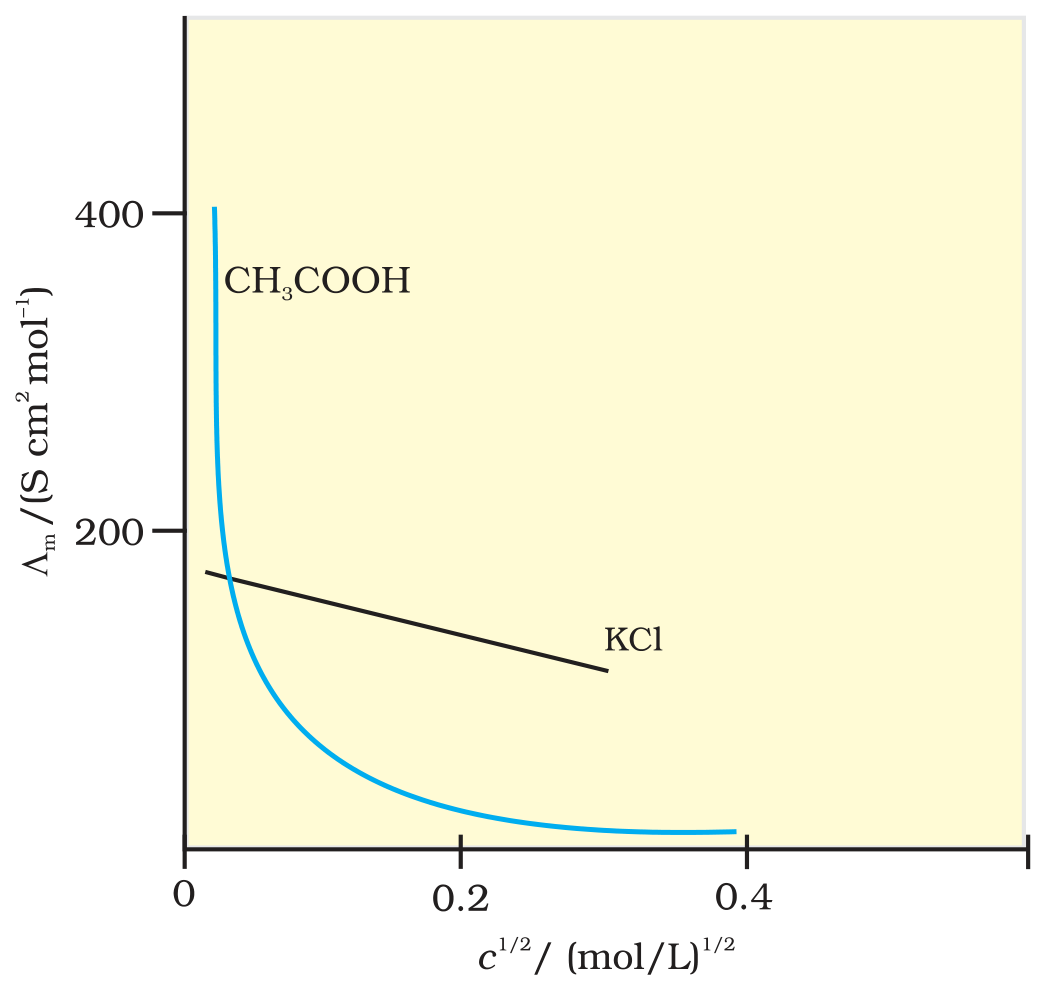
Fig. 2.6: Molar conductivity versus c½ for acetic acid (weak electrolyte) and potassium chloride (strong electrolyte) in aqueous solutions.