Match List-I with List-II:
| List-I | List-II | ||
|---|---|---|---|
| (A) | Training | (I) | Introducing the selected employee to other employees and familiarising him with the rules and policies |
| (B) | Education | (II) | Increasing the aptitudes, skills and abilities of employees to perform specific jobs |
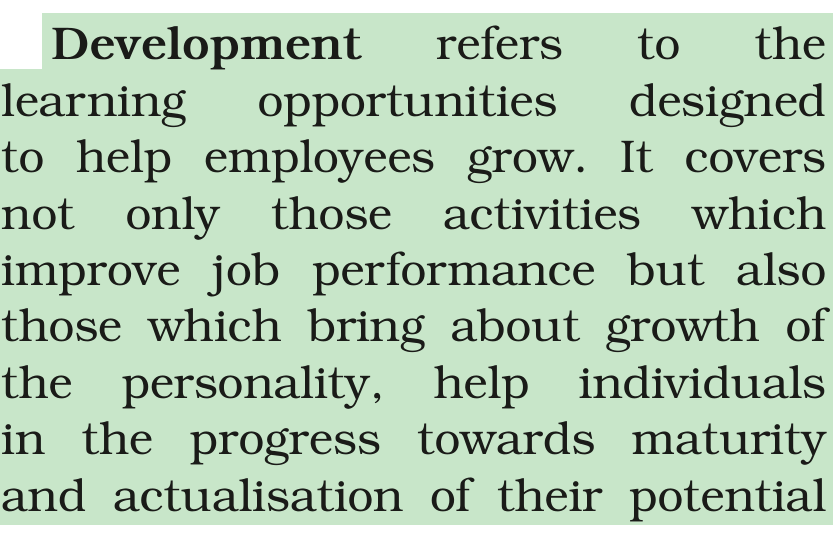
| (C) | Development | (III) | Building a logical and rational mind that can determine relationships among pertinent variables |
| (D) | Orientation | (IV) | Learning opportunities that help individuals progress towards maturity and actualisation of their potential |
Choose the correct answer from the options given below:
Answer & explanation
Correct answer: option 4
The correct answer is Option (4) → (A)-(II), (B)-(III), (C)-(IV), (D)-(I)
| List-I | List-II | Reason |
|---|---|---|
| (A) Training | (II) Increasing the aptitudes, skills and abilities of employees to perform specific jobs | Training builds skills for a specific job. |
| (B) Education | (III) Building a logical and rational mind that can determine relationships among pertinent variables | Education increases knowledge and understanding and trains the mind to reason. |
| (C) Development | (IV) Learning opportunities that help individuals progress towards maturity and actualisation of their potential | Development helps employees grow as persons, beyond their present job. |
| (D) Orientation | (I) Introducing the selected employee to other employees and familiarising him with the rules and policies | It happens when a new employee joins. |
Training serves one job, education builds understanding, and development grows the whole person.
NCERT (2026-27 Edition): “(iv) Placement and Orientation: Joining a job marks the beginning of socialisation of the employee at the workplace. The employee is given a brief presentation about the company and is introduced to his superiors, subordinates and the colleagues. He is taken around the workplace and given the charge of the job for which he has been selected. This process of familiarisation is very crucial and may have a lasting impact on his decision to stay and on his job performance. Orientation is, thus, introducing the selected employee to other employees and familiarising him with the rules and policies of the organisation. …” “Training, Development and Education … Training is any process by which the aptitudes, skills and abilities of employees to perform specific jobs are increased. It is a process of learning new skills and application of knowledge. It attempts to improve their performance on the current job or prepare them for any intended job.” “Education is the process of increasing the knowledge and understanding of employees. It is the understanding and interpretation of knowledge. It does not provide definite answers, but rather develops a logical and rational mind that can determine relationships among pertinent variables and thereby understand a phenomenon. Education imparts qualities of mind and character and understanding of the basic principles and develop the capacities of analysis, synthesis and objectivity. Education is broader in scope than training. Training is tied to the goals of organisations more than to the goals of the individual. …”
“… capacities so that they become not only good employees but better men and women. …” |