
CUETMOCK
  • Pricing
  • Mentors
Log inStart freeStart free mocks→

First test, then trust

Try a free CUET mock test.

Join 5,00,000+ students who rehearsed exam day on the exact NTA screen before sitting CUET. On the web and on Android.

Start free mocks →Get the Android app
CUETMOCK

India's #1 CUET Mock Test Platform. Original NCERT-based questions on the exact NTA exam screen — trusted by 5,00,000+ students since CUET 2022.

Get it onGoogle PlayScan to download the CUETMOCK app

Mock tests

  • CUET mock test series
  • Browse all papers
  • Commerce mocks
  • Humanities (Arts) mocks
  • Science mocks
  • Languages & GAT mocks
  • Free practice questions
  • Pricing

Resources

  • CUET exam guide
  • CUET syllabus
  • Universities accepting CUET
  • Expert blogs
  • News & notifications
  • Webinars & counselling
  • CUET score calculator
  • How we estimate your rank
  • FAQs

Company

  • About us
  • Our leadership & team
  • Our toppers
  • Mentors
  • For schools
  • Contact us
  • Terms
  • Privacy
  • Refund policy

Talk to us

+91 7696 6630 56info@cuetmock.comWhatsApp us

Our other platforms

  • JEE Mock — For IIT-JEE aspirants
  • NEET Mock — For NEET aspirants

Newsletter

Exam updates, study material and offers — no spam.

© 2026 NYC Ventures Pvt. Ltd.

701-702, Royal Business Park, Zirakpur, Punjab - 140603

  • Terms of use
  • Privacy policy
  • Refund policy
  • Contact us

iCUETMOCK is an independent preparation platform, not affiliated with the National Testing Agency (NTA). Always check exam details on the official NTA website.

  • Home
  • Mock tests
  • CUET guide
  • Pricing
  • Log in
Home/Practice questions/Chemistry
ChemistryOrganic: Haloalkanes and Haloarenes

What is the product formed when 4-Bromobutan-1-ol undergoes intramole…

The halogen atom in haloalkanes is more electronegative than the carbon atom attached to it. As a result, the atom acquires a partial positive charge and the halogen atom a partial negative charge.
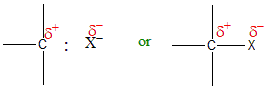
The presence of this small positive charge on the carbon atom makes it susceptible to attack by nucleophilic reagents. Thus, when a nucleophile stronger than the halide ion approaches the positively charged carbon atom of an alkylhalide, the halogen atom with its bonding pair of electrons is displaced and a new bond between the carbon atom and the incoming nucleophile is formed:

Such reactions in which a stronger nucleophile displaces a weaker nucleophile are called nucleophilic substitution reactions and the atom or group which departs with its bonding pair of electrons is called leaving group. The better the leaving group, the more facile the nucleophilic substitution reaction.

Amongst the halide ions, the order in which the leaving group departs follows the sequence:

\[I^− > Br^− > Cl^− > F^−\]

It is because of this reason that the order of reactivity of haloalkanes follows the sequence:

\[iodoalkanes > bromoalkanes > chloroalkanes > fluoroalkanes\]

There are two types of nucleophilic substitution reactions. These are:

(a)   Substitution Nucleophilic Bimolecular (SN2)

(b)   Substitution Nucleophilic Unimolecular (SN1)

What is the product formed when 4-Bromobutan-1-ol undergoes intramolecular Williamson synthesis?

Answer & explanation+

Correct answer: option 3

The correct answer is option 3. Tetrahydrofuran.

The Williamson ether synthesis is a method used to form ethers by the reaction of an alkoxide ion with a primary alkyl halide. When 4-bromobutan-1-ol undergoes an intramolecular Williamson synthesis, it forms a cyclic ether.

Here is the mechanism and product formation:

1. Formation of Alkoxide Ion: The hydroxyl group (-OH) of 4-bromobutan-1-ol can be deprotonated by a base, such as sodium hydride (NaH), to form the corresponding alkoxide ion.

2. Intramolecular Nucleophilic Substitution: The alkoxide ion then attacks the carbon atom bonded to the bromine atom, leading to the formation of a cyclic ether.

The reaction proceeds as follows:
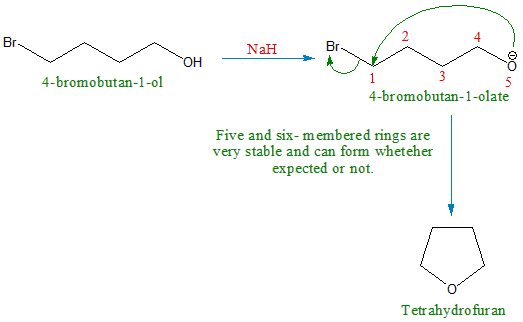


The cyclic ether formed in this intramolecular reaction is tetrahydrofuran (THF), a five-membered ring containing one oxygen atom. Thus, the product formed when 4-bromobutan-1-ol undergoes intramolecular Williamson synthesis is \(\text{Tetrahydrofuran}\).

Advertisement

Practise more on Organic: Haloalkanes and Haloarenes

Chapter-wise mocks on the real NTA exam screen, with solutions and your rank. Your first mocks are free.

Start free mocks →

Advertisement

Next questions

  1. Select the Misspelt word.English · Spelling Check
  2. Four number-pairs have been given, out of which three are alike in some manner and one is different. Select the number-pair that is differe…General Aptitude Test · General Ability
  3. In India, Brahmaputra river flows through which of the states?General Aptitude Test · General Knowledge
  4. Select the word-pair in which the two words are related in the same way as are the words in the following word-pair. Paper : PulpGeneral Aptitude Test · General Ability
  5. The principle of reciprocal inhibition operates in which of the following techniques?Psychology · Therapeutic Approaches
  6. <p><strong>Identify the correct order of Needs as per Maslow’s Need Hierarchy Theory.</strong></p> <p>(A) Safety and Security needs</p> <p>…Business Studies · Directing
  7. Given below are two statements: one is labelled as Assertion (A) and the other is labelled as Reason (R). Assertion (A): Poor management is…Business Studies · Nature and significance of Management
  8. Which of the following is not a chemical change?General Aptitude Test · General Knowledge
  9. ______ is a kind of tropical version of the industrial dwelling of Victorian London's East End. Fill in the blank with correct option.Geography · India-People and Economy: Geographical Perspective on selected issues and Problems
  10. The area of a rectangle is 180 cm^2 If the ratio of length and breadth of the rectangle is 5 : 4, then what is the length (in cm)of diagona…General Aptitude Test · Quantitative Reasoning