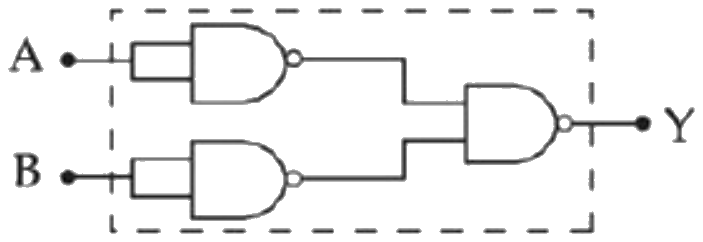
The logic circuit given below will act like
Answer & explanation
Correct answer: option 3
The correct answer is Option (3) → OR gate
A NAND gate with its two inputs joined acts as a NOT gate. So the first two gates give \( \bar{A} \) and \( \bar{B} \), and these are the inputs of the last NAND gate.
\( \displaystyle Y = \overline{\bar{A}\cdot\bar{B}} \)
By De Morgan's theorem, \( \overline{X\cdot Z} = \bar{X} + \bar{Z} \):
\( \displaystyle Y = \bar{\bar{A}} + \bar{\bar{B}} = A + B \)
This is the Boolean expression of an OR gate. Check with the truth table:
\( A = 0,\ B = 0:\ \bar{A}\cdot\bar{B} = 1,\ Y = 0 \)
\( A = 0,\ B = 1:\ \bar{A}\cdot\bar{B} = 0,\ Y = 1 \)
\( A = 1,\ B = 0:\ \bar{A}\cdot\bar{B} = 0,\ Y = 1 \)
\( A = 1,\ B = 1:\ \bar{A}\cdot\bar{B} = 0,\ Y = 1 \)
Note: This question is from the pre-rationalised NCERT book (2022-23). The topic was removed from the latest NCERT book (2026-27), and it also appears to be out of the CUET 2026 syllabus.
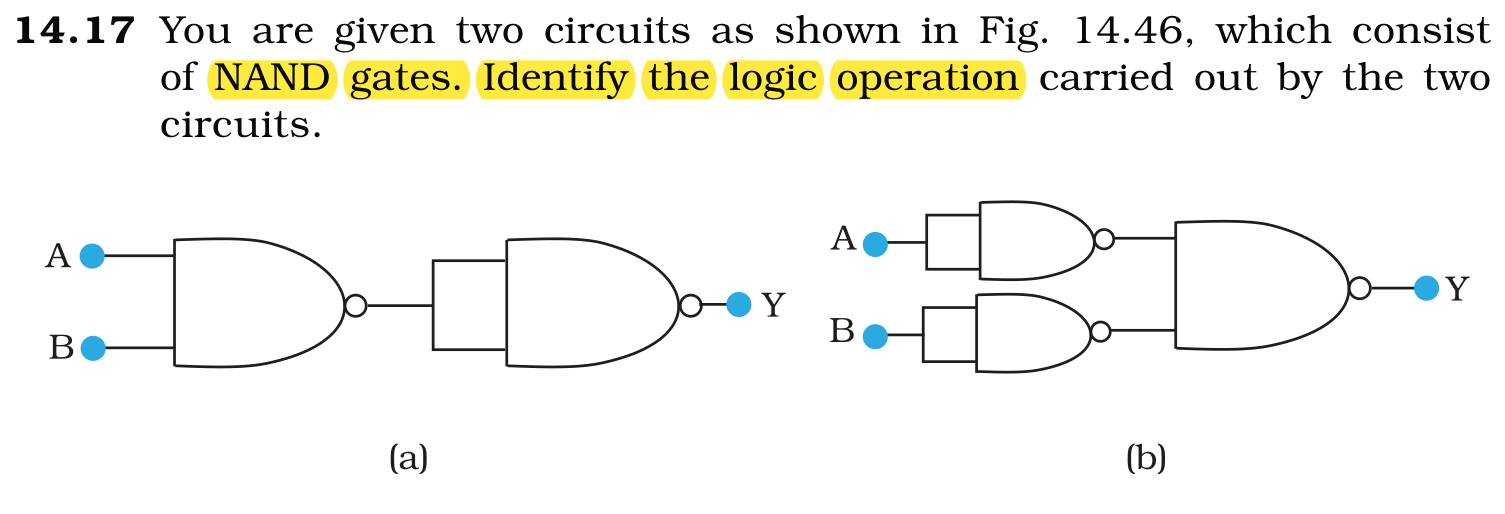
NCERT (Pre-rationalised edition, 2022-23):
Additional Exercises – …