A company has a total investment of Rs. 60 lakh, which includes debt of Rs. 20 lakh at 12% p.a. The tax rate is 30%. Compared with raising the whole amount through equity, below what level of EBIT will the use of this debt reduce its earnings per share (unfavourable financial leverage)?
Answer & explanation
Correct answer: option 4
The correct answer is Option (4) → Rs. 7.20 lakh
Given:
Total investment = Rs. 60 lakh
Debt = Rs. 20 lakh at 12% p.a.; Tax rate = 30%
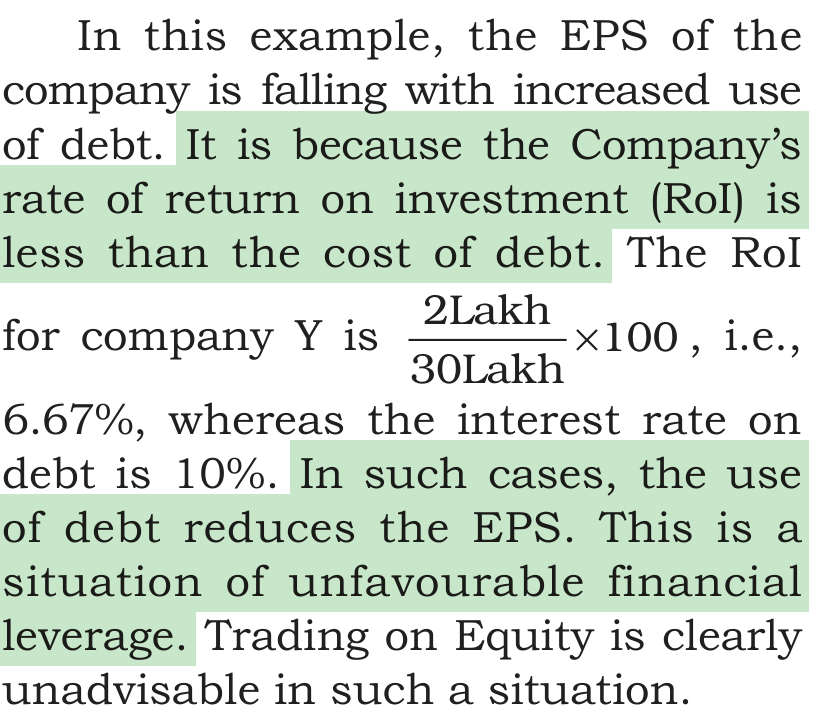
Financial leverage is unfavourable when the return on investment (RoI) is lower than the cost of debt.
RoI = EBIT ÷ Total investment × 100
Turning point: RoI = 12%
EBIT = 12% of Rs. 60 lakh = Rs. 7.20 lakh
Below Rs. 7.20 lakh, RoI falls under 12%, so the debt pulls the EPS down.
Option (1) Rs. 5.04 lakh — Incorrect. This uses the after-tax rate: 12% × 0.70 = 8.4%, and 8.4% of 60 gives 5.04. RoI is compared with the interest rate on debt.
Option (2) Rs. 4.80 lakh — Incorrect. This takes 12% of the equity of Rs. 40 lakh only. RoI is worked on the total investment.
Option (3) Rs. 2.40 lakh — Incorrect. This is only the interest, 12% of Rs. 20 lakh. At this EBIT the earnings after interest are nil.
The tax rate does not move this point, as tax cuts both EPS figures by the same share.
NCERT (2026-27 Edition): Example II
|