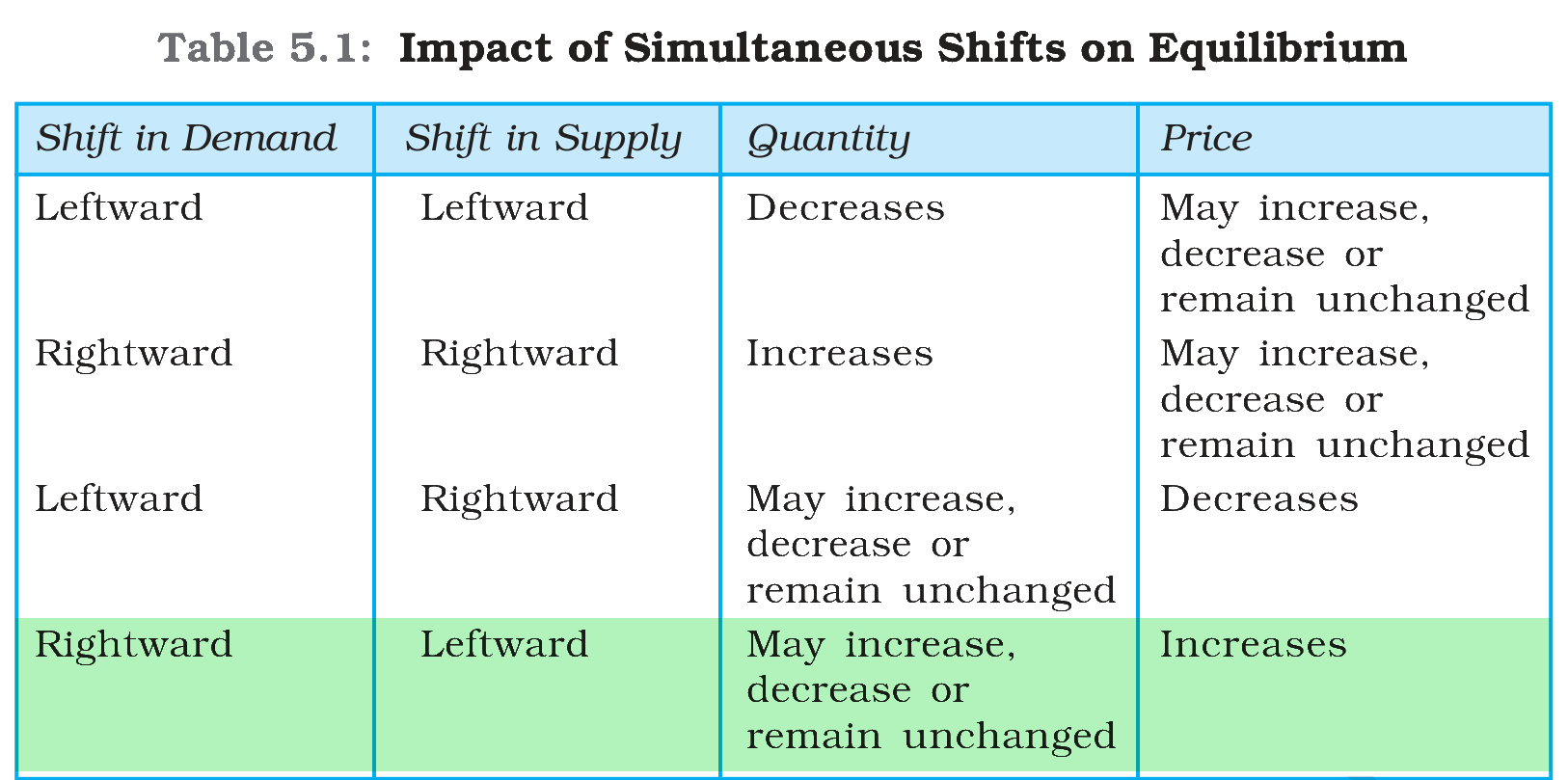
In a market with a fixed number of firms, qD = 400 – 2p and qS = 100 + 2p (p in rupees). The number of consumers rises, so that 40 more units are demanded at every price. At the same time, the price of an input rises, so that 40 fewer units are supplied at every price. Compared with the old equilibrium:
Answer & explanation
Correct answer: option 4
The correct answer is Option (4) → the price rises by Rs 20 and the quantity stays the same
Given:
qD = 400 − 2p
qS = 100 + 2p
New demand: 40 more units at every price
New supply: 40 fewer units at every price
Find the equilibrium before and after, where demand equals supply.
Old equilibrium:
\( 400 - 2p = 100 + 2p \)
\( 4p = 300 \)
\( p = 75 \)
\( q = 400 - 150 = 250 \)
New equilibrium, with qD = 440 − 2p and qS = 60 + 2p:
\( 440 - 2p = 60 + 2p \)
\( 4p = 380 \)
\( p = 95 \)
\( q = 440 - 190 = 250 \)
The price rises by Rs 20 and the quantity stays at 250. Demand moved right and supply moved left by 40 units each. The two curves here are equally steep, so the two effects on quantity cancel, while both push the price up.
NCERT (2026-27): “Simultaneous Shifts of Demand and Supply … In the first two cases which are shown in the first two rows of the table, the impact on equilibrium quantity is unambiguous but the equilibrium price may change, if at all, in either direction depending on the magnitudes of shifts. In the next two cases, shown in the last two rows of the table, the effect on price is unambiguous whereas effect on quantity depends on the magnitude of shifts in the two curves.”
|